

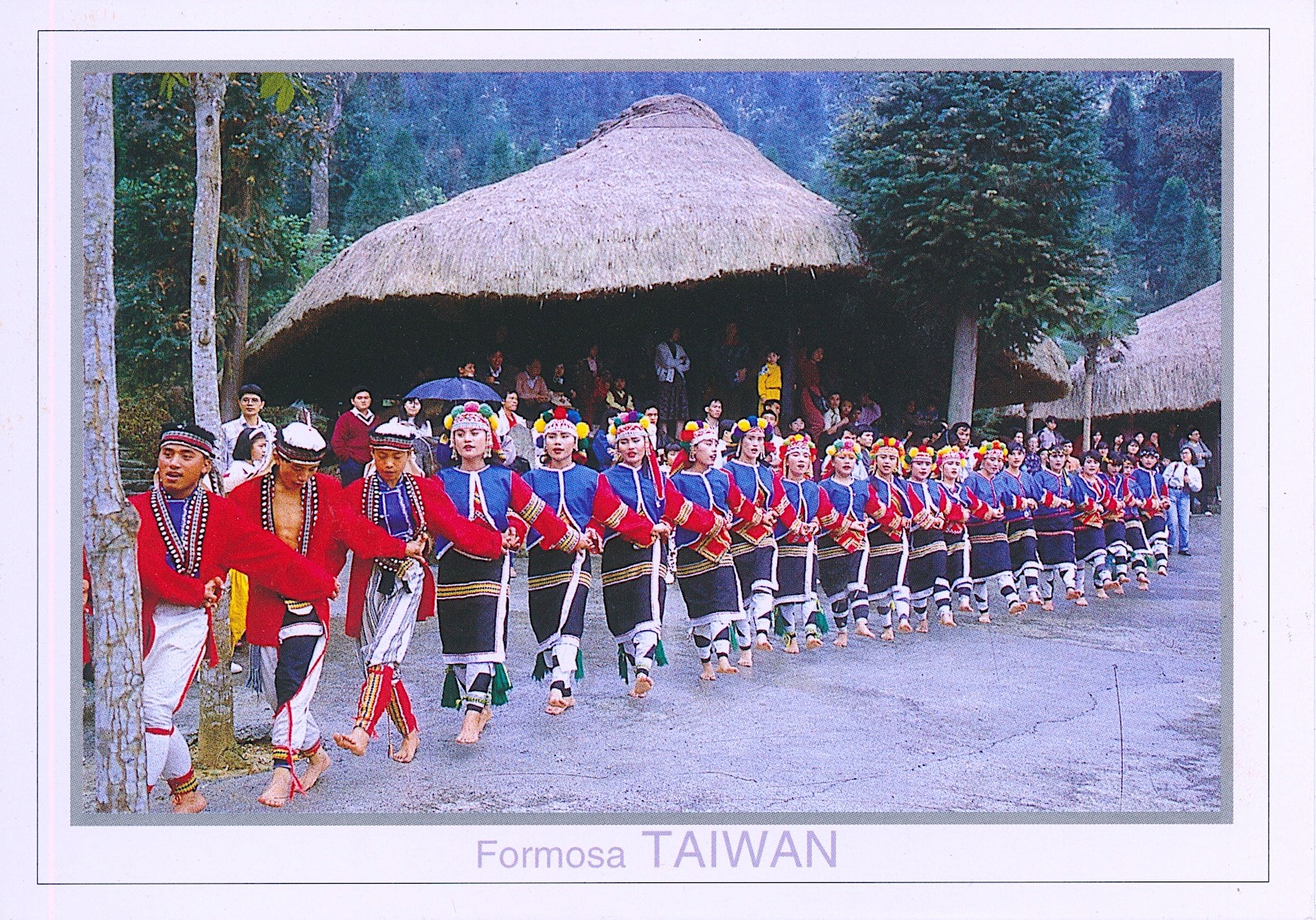
After the defeat of Chiang Kai Chek’s armies by the communists in the Chinese civil war, the nationalists retreated to this island in the South China Sea in 1949. Here they set up an independent Chinese government, preserving the centuries-old traditions of their homeland which Mao Tse Tung was doing his best to destroy on the newly communist mainland.
Storybook temples framed by flaring dragons rear around every corner. Miniature shrines, like telephone booths, house buddhas who preside over railway sidings. Cacophonous fireworks add to the crescendo of rush-hour traffic as mythological figures parade through the alleys accompanied by dancing paper dragons, ten-men-long. The priceless treasures of centuries of Chinese creativity, rescued from the mainland, are sheltered in the National Palace Museum in Taipei.
The Chinese, however, were not the island’s first inhabitants. Archaeological evidence of human occupation dates back 10 000 years but written history begins with the succession of colonial waves which preceded the nationalists. Fujienese and Hakka tribes from mainland China were among the earliest settlers. Then the Europeans came. In 1517, the Portuguese named it Formosa for its beauty. The Dutch followed a hundred years later. The Spanish annexed northern Taiwan before the Dutch expelled them. The Dutch gave way to a new Chinese invasion and later, the spoils of war brought the Japanese at the end of the 19th century. However, the original inhabitants of this island had very different roots, and their distinctive culture survives in the mountainous interior of central and south-eastern Taiwan.
We took the road to Alishan, my Chinese teacher and I, headed for an indigenous village with the alluring name of ‘Happy Wilderness’ (Ler Ye). We were to stay with a local family of the Tsou clan – one of 16 officially recognised tribes in Taiwan. Together, they make up a mere 2.5% of the island’s teeming population of 23 million.
As the scenery grew greener and the air cleaner, we entered a different Taiwan, one which I was unable to sufficiently appreciate at first, being far too preoccupied with keeping down my lunch as the bus careened around hairpin bends. As we climbed through the cloud cover, the thickly wooded mountain scenery unfolded; each mountain layered one behind the other in misty one-dimension, like monochrome classical Chinese landscapes.
We were finally deposited at the top of a dusty, mountain road and followed its snaking descent to be met by the sight of the village sprawled between terraced hillsides. From the road above, swatches of colour smeared the valley – here a blue roof, there a lime-green door or a canary-yellow wall – the flourishes of colour echoing the scattered flowers peeking from pots and draping walls and flung over the verge of the road – busy lizzies and azaleas, hydrangeas and bougainvillaea. The village itself was a haphazard collection of piecemeal corrugated-iron dwellings with additions and extensions tacked on as the need for expansion arose.
We shared dinner with the family that night outside in the gathering darkness. Tea terraces sliced the mountains into geometric layers, the lines softened by evening mist shredded into pink candy floss by the setting sun. Such was the backdrop to river shrimp and sweet potato, wild pig and bamboo casserole and the inevitable pot of sticky rice – a glutinous mass that required two people wielding chopsticks to divide into portions.
Later that night, over myriad cups of strong black Chinese tea, I spoke with an old aboriginal man who had stopped to swap stories for brandy. His skin was the colour and consistency of melted caramel and a thick, white shock of hair crowned his head like a dollop of whipped cream. He spoke of his twenty years of imprisonment after an aboriginal uprising against the waishengren or ‘outer province people’ – the 1949 Kuomintang refugees from newly communist China. Yet despite such treatment at the hands of the Chinese, he had donned the robes of his jailers and considered himself Chinese – perhaps coming to share in the Chinese conviction of their cultural superiority. He desired reunification with the mainland – a place that he has never seen and has no ties to. He did not regard the ideological differences between the two countries as problematic but has no doubt that should Taiwan officially declare independence, China would invade and conquer. He became somewhat boisterous after several generous brandies and I was dismissed by the younger men as the talk turned bawdy.
The next day we travelled to the main village of the Tsou in order to see the ‘Man’s House’, a thatched, open-plan construction which figures largely in the tribe’s traditions and ceremonies. It is here that boys who come of age are entitled to sleep and no women are allowed on the upper floor of the two-tiered bamboo structure. Our guide directed our attention to a shadowy corner of the top floor and told us with some relish that this was where the heads of enemy chieftains once found their final resting place. August 15th is the grand year-end festival which once celebrated the gathering of enemy heads and still marks the coming of age of the clan’s fledgling warriors. The ceremony involves the killing and roasting of a pig and the pruning of the sacred banyan tree which stands outside the house.
The diverse indigenous tribes scattered throughout Taiwan share a common Austronesian ancestry. As they lack a written history however, my guide – a social geographer notwithstanding – was unable to tell me the origins of his people; so different in culture and appearance from the local Chinese – the dark, coffee-coloured skins and round eyes, the strong, strapping men and round, brown women. Heavier than their dainty, boyishly slender Chinese sisters, the women have doe eyes and soft cheeks and hips that swell with the promise of sweet, undulant love-making … or so the Dutch colonists found in the 17th century, when soldiers fleeing the victorious Chinese armies of Koxinga sought refuge in the mountains and found it in the arms of the round, brown, mountain women. That heritage can still be seen in the sudden flash of European from a dusky face – here a pair of sculpted cheekbones, there a lighter shade of hair.
And so these people – the original inhabitants of an island once named for its beauty – have watched the endless procession of shifting powers and loyalties, the cultures which have been implanted and overturned, and still they live in the mountains as they have done for centuries; conceding economic realities by growing tea. It is a life of subsistence rather than the affluence and ostentation which characterises the cities, but up here in the mountains, it is as though the clamorous demands of modern urban life are mere tales full of sound and fury.
The mountains and their people are as anachronistic and unexpected as Shangri-La … and as fragile. In a village such as this with no more than 200 inhabitants, it is the children and the old that are left to tend the community’s livelihood. The sons and daughters live and study in the cities, drawn by the money and opportunities. Their mother tongue is soon superseded by the Mandarin they are taught in school.
In the main village of the Tsou, there is a piece of sculpture set against the wooded gorge. It shows a man – his muscled body scantily clad in a loincloth, a spear clasped in his bulging arm. Beneath the feathers he wears on his head, his hand scans the horizon as though seeking a glimpse of his future. For these forgotten people with no remembered past and no foreseeable future, the present they occupy is a precarious perch, high in the clouds, above the swarming ant colonies down below.