

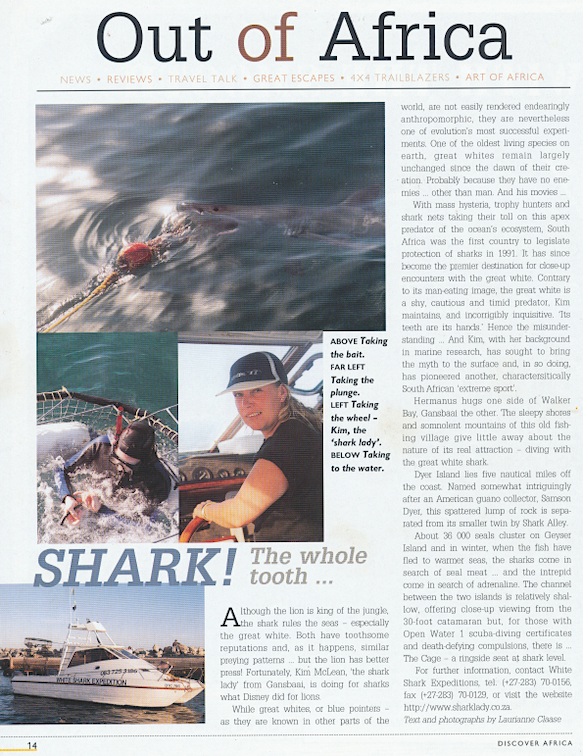
While great whites – or blue pointers as they are known in other parts of the world – are not easily rendered endearingly anthropomorphic, they are, nevertheless, one of evolution’s most successful experiments. One of the oldest living species on Earth, sharks have remained unchanged since the dawn of their creation. Probably because they have no enemies – other than Man. And his movies.
With mass hysteria, trophy hunters and shark nets taking their toll on this apex predator of the ocean’s ecosystem, South Africa was the first country to legislate protection in 1991. Today, it is one of the premier destinations for close-up encounters with the Great White Shark.
Contrary to their man eating image, the Great White is a shy ,cautious and timid predator, –Kim maintains – and incorrigibly inquisitive; “Its hands are its teeth.” Hence, the misunderstanding.
Kim, with her background in marine research, sought to bring the myth to the surface and in so doing pioneered another, characteristically South African, extreme sport.
Hermanus hugs one side of Walker Bay, Gansbaai the other. The sleepy shores and somnolent mountains of this old fishing village give little away about the nature of its real attraction – diving with the Great White Shark.
Dyer Island lies five nautical miles off the coast. Named, somewhat intriguingly, for an American guano collector named Samson Dyer, this spattered lump of rock is separated from its smaller twin by Shark Alley. Some 36 000 seals cluster on Geyser Island and in the winter months of June, July and August when the fish have fled for warmer seas, the sharks come in search of seal meat. And the intrepid come in search of adrenaline. The channel between the two islands is relatively shallow offering close-up viewing from the 30-foot catamaran but for those with Open Water 1 scuba-diving certification and death- defying compulsions, there is … The Cage – a ringside seat at shark level.