

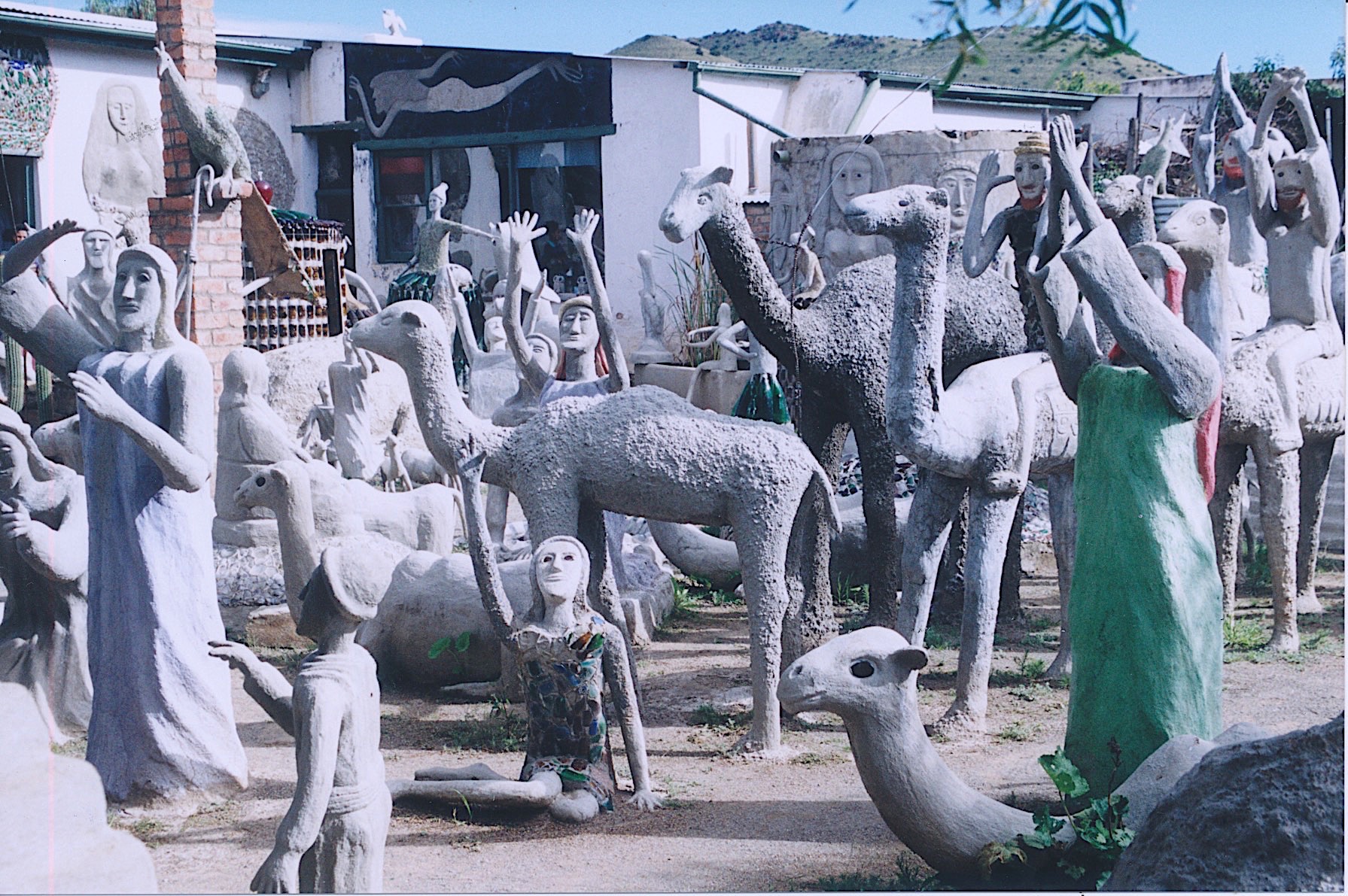
Ashen women with beer bottle skirts lean forward in welcome, their fingers pointing east. Pallid mermaids beckon from sun-dried pools, directing attention towards the pilgrimage behind them. Concrete camels and wise men, buddhas and sphinxes, owls and pyramids and lotus-legged potentates face towards EAST in frozen adoration. The word is written on the wire fence somewhere near the rising sun. The Mona Lisas look on from the water tank in quiet resignation and the phalanx of owls on the window sill are stony-faced critics. Beyond the wire fence and high walls of the Camel Yard with its 550 sculptures, the oaks glisten green and gold and give voice to the wind.
Today, the tragic and enigmatic figure of Helen Martins still haunts her astonishing creation, born from a potent mix of religious fervour, sex and death, Omar Khayyam and William Blake.
The Owl House, South Africa – Helen Martins
Born in December 1897, Helen Martins was the youngest of six children. She left home for a period, graduated as a teacher, married and moved away but by the 1930s she was back to care for her aged and ailing parents.
Helen’s mother died in 1941 and her father followed four years later. He had been a moody and difficult man and she had called him ‘The Lion’. She bricked up the sick room’s only window, painted the walls black and smeared them with crushed glass. On the step outside she scoured ‘The Lion’s Den’ into the wet concrete and thereafter used the room only for storage purposes. It was then, in her late 40s, with few prospects of marriage or escape, that she began to transform her bleak and lonely surroundings and was to spend the next 25 years re-shaping reality. In a cluttered corner of the Camel Yard outside, an old man stands with distended belly, hunch-backed and misshapen with his back leg still caught in the block of concrete from which he was fashioned. The Lion’s Den is now the reception area for visitors to the museum.
Miss Helen became increasingly shy as she grew older and shunned the company of other people. Finally, at the age of 78, with her eyesight failing and the light literally seeping from her world, she swallowed caustic soda. It took her three days to die.
Rock Garden of Chandigarh, India – Nek Chand
A Punjab labourer who was dispossessed by the 1948 partition of India, Nek Chand came to Chandigarh in 1951, where a whole new city was being built. He worked by day as a road inspector for Public Works but by night he moonlighted as an artist. He illegally cleared a piece of government land where he began to erect his cement and concrete figures, rag dolls and animals, all moulded from urban rubbish – rags and feathers, broken crockery, oil drums, even bicycle saddles.
His impromptu gallery of almost 2 000 figures was discovered in 1972 and rapidly became a public attraction. So much so, that in 1976, the city encouraged Chand to work on the sculptures full time by giving him a salary, 50 labourers and a truck. The war was not yet won, however, as development pressure mounted to build a road and a car park in the midst of his stone city. Once again public outcry staved off the bulldozer and the Rock Garden of Chandigarh was depicted on an Indian postage stamp in 1983. Its creator has become an international figure who has had exhibitions in Berlin, Paris and London. Chand’s artistic vision has also given rise to one of the largest recycling programmes in Asia. Today, his 654 acre ‘kingdom of the imagination’ is visited by 1.5 million people a year.
Bottle Village, California, USA – Grandma Prisbrey
Born in Minnesota in 1875, Tressa Prisbrey didn’t have an easy time of it. She was only 15 when she married her 52-year-old husband and went on to raise seven children singlehandedly after losing two spouses. She also outlived a fiancee, six kids and all of her siblings but one.
In 1930, she settled in California on a quarter-acre plot in Simi Valley. It was here, in 1956, that she began her life’s work. She had always been an avid collector of dolls and pencils and her hoard numbered 17 000 when she started building bottle houses to contain them. During the quarter of a century between 1956 and 1981 she used materials gathered from rubbish dumps to fashion 22 houses, walls, walkways, fountains and shrines. As her opus grew, she charged interested passers-by $0.25c for a guided tour, which was usually followed by risque 1920s songs on the piano in the meditation room.
Like Nek Chand, her work found mainstream acceptance without her looking for it and she had five major exhibitions, two of which went to Europe, from 1974 to 1979. She sold the Bottle Village property in 1972, returning in later years as a caretaker before finally leaving it behind for good in 1982 when she moved. She died not long after, in 1988, aged 92.
The Village fell into disrepair with Grandma Prisbrey gone and was damaged further by the Northridge Earthquake on 17 January 1994. The epicentre of the 6.7 scale earthquake was a mere 8 miles away from Bottle Village. Today, 13 buildings and 20 sculptures teeter, on the brink of the San Andreas fault.
Watts Towers, Los Angeles, USA – Simon Rodia
Born in 1879 to Italian immigrants, Simon Rodia was a contemporary of Tressa Prisbrey. He sailed to America when just 15 and provided his unskilled labour to construction sites. Offsite, between 1921 and 1955, he raised a tower complex almost 30 metres tall (100 feet), initially to house a religious-based community centre for the middle-class Los Angeles suburb of Watts.
His towers grew from a steel rod skeleton clothed in cement and reinforced wire. Gaudi-like, he ‘stuccoed’ his spires in the flotsam and jetsam of urban life: glass and tiles, china pottery and shells, 7Up and Milk of Magnesia bottles. Ignoring his neighbours’ loudly expressed incomprehension, he complemented the towers with mosaic fountains and birdbaths and walkways. With no set plan, he raised and levelled his constructions as the fancy took him. Then, in 1955, he reached the end, gave away the land and its fantastical construction to a neighbour and went off to die.
Four years later, in 1959, the Watts Towers were under threat of demolition for failing to comply with building code. Rodia was tracked down and told the news but was unmoved. The Towers escaped demolition but as the middle-class neighbourhood declined into an inner city slum, the towers deteriorated.
In 1975 the Watts Towers were declared a National Historic Landmark and, in 2001, the site has was restored and re-opened to the public, providing an evocative symbol of affirmation in the midst of urban decay.
Coral Castle, Florida, USA – Edward Leedskalnin
On an internet search, you’ll find Edward Leedskalnin in the esoteric company of subjects such as levitation and magnetism, geomancy, anti-gravity and harmonics.
Jilted Lativan lover, Leedskalnin, came to America a broken-hearted young man and landed up in Florida City, 25 miles south of Miami. In the 1920s, this was where a man came who wanted to ‘get away from the world’. Here, on an acre of land on the edge of the Everglades, he began to build the edifice that would prove to his fickle fiancée that he was no slouch. His medium of choice was coral.
The walled castle is hewn from 1 000 tons of coral and furnished with another 100 tons. The first floor, he used as his workshop while the second floor was his residence, guarded by an 2.5-metre-high (8 foot) wall of megalithic coral. He furnished the towers with coral rock furniture including a monolithic rocking chair, a table in the shape of Florida, obelisks and telescopes guarded by a nine-ton gate. When he moved house, to a more spacious 10 acres near the aptly named Homestead, Florida, he took ‘Coral Castle’ with him, to its present site. How he moved the massive coral blocks, some weighing up to 35 tons, remains a mystery to this day. When asked how he had managed, he claimed to have discovered the levitating secrets of the Ancient Egyptians and their megalithic builders but he wouldn’t divulge anything more. He went to his death in 1951 without passing on the secret.