

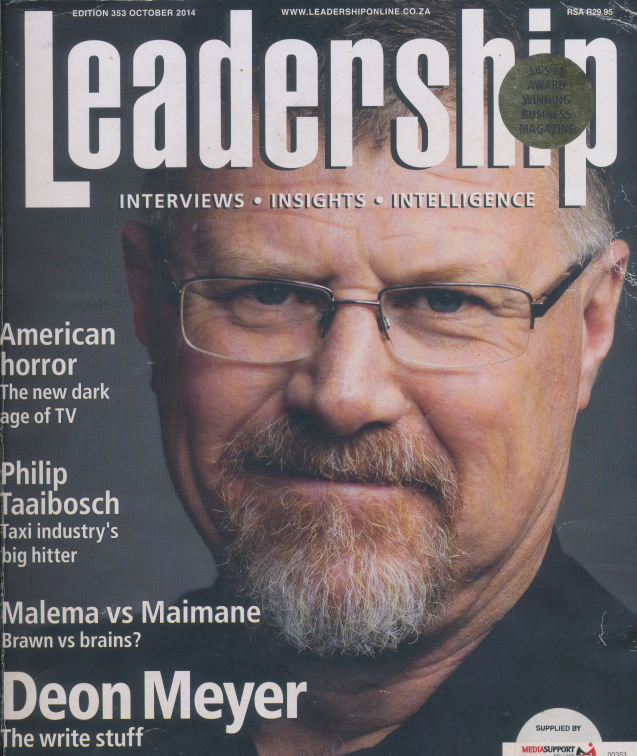
Klerksdorp’s most famous literary son counts Ian Rankin and Michael Connelly as friends. The ‘King of South African crime’, Afrikaans author Deon Meyer, never dreamed of being a published writer. Yet his novels have been translated into 28 languages. He is the recipient of numerous international awards, including the Barry in America – ‘probably the toughest market in the world’ – and two of his books are currently being made into movies. English actor Sean Bean, who played Boromir in Lord of the Rings, and Eddan Stark in Game of Thrones, is being touted to play Meyer’s much-loved cop, Benny Griessel, who features in his latest release, ‘Cobra’.
Early years
Deon was born in Paarl in 1958, but grew up in the North West mining town of Klerksdorp, where his father worked for Otis Elevators. The Meyer family were ‘lower-middle-class white Afrikaners in a town that was not known for its culture,’ Meyer recalled with elegant understatement. ‘The urge was there to write but I never had this concrete dream of I want to be a published writer. I just never thought in those terms. Authors were very sophisticated people who smoked pipes and thought deep thoughts. That just wasn’t me. I also didn’t think I’d be able to do it. I mean, I’m from Klerksdorp, for God sake. How can someone from Klerksdorp become a full-time author?’
His parents, however, were readers and there were always books in the house. When they saw that the three boys took an interest, they actively encouraged them. His father took the boys to the library as often as they wanted to go. His mother introduced Deon to World War 2 non-fiction. ‘The influence that books had on my development, on me as a human being, are just immeasurable. I still think if parents want their kids to read, then set that example. Reading is the thing that creates all writers. Writers that don’t read will never be successful. I just read a lot.’
Why crime?
In all that reading, Meyer discovered American crime and thriller writers Ed McBain and John D Macdonald, whose novel ‘The Executioners’ was popularised in the 1991 movie Cape Fear. ‘When I discovered the genre, I just absolutely fell in love with it. Although I read much more than crime fiction, it’s the genre I really loved reading most.’ Yet, when he started writing novels, he didn’t set out to write crime.
‘I just had a story to tell. It was only after my second novel that I was being branded as a crime author. I thought that’s cool. If that’s what I am, fine. I still don’t think in terms of genre. I think in terms of story.’
At the time, the country was in the iron grip of the National Party, and local crime fiction was non-existent. Apartheid-era cops did not make hero material.
‘The kind of stuff I wanted to write back then – this was still in the last years of apartheid – there was nothing on the market in Afrikaans in the crime and thriller genre. You need a democracy for crime fiction to blossom. You can’t have a cop as a hero of a book when he represents an evil regime.’
Mastering the craft
In order to satisfy his ‘urge to tell stories,’ Meyer took a pragmatic approach. At the time, he was juggling his work as a reporter for the Volksblad in Bloemfontein, and later as an advertising copywriter, with his responsibilities as a single parent. Meyer realised that if he wanted to invest time in writing, ‘it had to have a very specific pay-off in terms of my investment’. He signed up for a TV writing course and, much to his surprise, won the drama category in the competition to write a TV pilot episode. The SABC were going to produce the TV show but budgetary cut-backs sent Deon Meyer back to square one. Undaunted, he started writing short stories, as the best way to learn his craft. His first story was published in Huisgenoot. As his confidence grew, he decided to attempt a full-length novel.
‘I got up every morning at 04:00 and wrote until 07:00, when the kids woke up. It took me two years to finish my first novel in that fashion. You still don’t know if it’s going to be accepted. Happily, it was. Then, you get more confidence from that and you start writing the next book. So, for me, it was always this balancing act. How do I invest time and effort without it being a fruitless pursuit?’
On the road to success
Since 1994, crime writing has flourished in South Africa, with Meyer leading the charge. His first novel, ‘Wie met Vuur Speel’, was published in Afrikaans in 1994. ‘Feniks’ came out in 1996, two years after Nelson Mandela became President of South Africa.
‘I was a little bit lucky, I think, that after the end of apartheid the world had an appetite for South African stories. So that gave me a little bit of a break in terms of establishing myself. The timing was good. I was the first post-apartheid new thing out of South Africa that was available to the international market because I had an agent. That was pure luck.’
However, Meyer still had to contend with the legacy of apartheid, especially in Europe. It took him 18 years to break into the Dutch market ‘because that is how long Dutch people were not willing to read crime fiction from an Afrikaans author’.
But Deon had taken the advice of others in the field to heart. ‘A lot of really successful authors like Michael Connolly and Ian Rankin told me from the very beginning, just keep on publishing because you have to build your audience, book by book. It took Rankin nine books before he could write full-time. It’s like any product. You’ve got to build a brand and build an audience. You’ve got to have patience.’
Escapism and realism
‘Dead before Dying’ (1999) was his first real crime novel and the first to appear in English. From the outset, Meyer’s novels reflected a changing society as he looked at the world through the eyes of his characters. The four main characters in ‘Dead before Dying’ have different views on the new South Africa but all seek to put the past behind them and find a new life and identity.
In ‘Heart of the Hunter’, the protagonist, a former freedom fighter and KGB-trained assassin is black, something that hadn’t been done in South African/Afrikaans crime fiction to that point.
‘Thirteen Hours,’ (2011), for which Meyer won the Barry Award for ‘best thriller’ in the US, introduced a black, female cop.
In ‘Devil’s Peak’, (2004) where the aging, Afrikaner cop, Benny Griessel, with his booze problem and flagging libido makes his first appearance, sexual violence against women and children is a major theme.
Twenty years into the new South Africa, Meyer’s latest release, ‘Cobra’, reflects the country’s disillusionment with the new regime. A whistle-blowing State Security employee says of her bosses: ‘With great power comes great responsibility. That sort of information would give our government great power, Captain. I don’t think our government can be trusted with such great responsibility.’
According to the Global Corruption Barometer of 2013, 83% of South Africans surveyed believe that the police are corrupt.’ Meyer doesn’t share this view. While researching Benny Griessel’s move to the Hawks, Meyer spent time with the elite unit. ‘I talk to a lot of policemen and women so I know what’s happening in the police.’ In ‘Cobra,’ the cops take a principled stand against their political bosses, determined to solve the crime, even if it means disobeying orders.
‘We have 200 000 policemen and women working in the service at the moment. The vast majority of them are not corrupt and are doing an adequate job. Some of them are doing a fantastic job,’ enthused Meyer. ‘You go to the Hawks and you see the dedication. You see how hard those people are working for the little money that they get paid, it is astonishing … I think the police are getting an extremely bad deal and are getting blamed for the few bad apples that are there. Why are the prisons so full? Why are the courts so backlogged? Someone’s got to be doing their job.’
Meyer has travelled widely – one of the perks of the job – spending time in police stations around the world.
‘Forensic backlogs you find everywhere in the world. Our CSI department in Plattekloof has got one of the most modern facilities in the world. In America, it’s even worse than it is here. South Africans tend to be extremely negative about everything, because they don’t have the perspective that, actually we’re not doing too badly compared to the rest of the world. Sure, we’re not doing as well as we would like to, but, in general, it’s not bad at all.’
Mindful, therefore, of the popular perception, both home and abroad, that South Africa is a crime-ridden society, Meyer has to tread that fine line between realism and escapism. How to make a South African crime story entertaining rather than upsetting?
‘To a large extent, especially in a market like America, writing a book about Africa is detrimental to sales because Americans are not interested in Africa. They see Africa as a place where there are lots of hungry children and the Ebola virus and civil war.’ His solution: ‘If it has entertainment value put it in. If it can add to the suspense; if it can add to the friction and make the lives of the characters a little more difficult; if it adds to the story – but otherwise don’t do it.’
Research
His novels are meticulously researched. He’s a news junkie, spends time with the police, interviews experts and reads as much as possible. He’s an avid collector of ideas and once he’s strung together three or four into a concept, he starts developing the story in his head.
‘I think fiction writing is a lot about creative choices that you make. Research multiplies your creative choices. The planning is a continuous thing. You keep changing the plans as the journey continues. That is what makes writing exciting and that is why I love doing it. It’s not a predictable thing. There isn’t a recipe that you follow. It’s a journey of exploration and discovery.’
Proudly South African
Meyer’s work is distinctly South African, in its setting, its dialogue and its characters, yet he has achieved an international following,
‘For the same reason,’ he explained, ‘that Swedish or American or British, or French crime fiction works in other countries. A story is a universal language and human character is human character irrespective of where they live. Those are the two basic building blocks that will make books accessible and popular anywhere in the world. The setting is secondary.’
And yet Meyer’s landscapes are almost characters in their own right, particularly his evocation of Cape Town. Meyer’s eye for detail, his use of actual street names, shops and hotels, adds to the realism of his novels. He takes photographs of his settings in order to recreate them on the page in vivid detail. Belville Station makes an appearance in ‘Cobra’, with its Little Somalia, its Nigerian money-changers and drug dealers, and informal traders selling counterfeit brands made in China. Tyrone the pickpocket rides the Metrorail trains.
‘My passion and my love is for South Africa and its people. I write about things that excite me either intellectually or emotionally. An algorithm that the State Department in the US has developed to sniff out terrorists in the banking system (the plot premise of Cobra) – that fires my imagination on an intellectual level. Cape Town moves me on a very emotional level. South Africa is just so much more exciting than any other country. So I’ll keep on writing South African novels.’
What’s next?
The next one is already in the works, another Benny Griessel book, partly because of popular demand.
‘When you get enough feedback from editors, publishers and readers, you get pressured into focusing on the next Benny story. But I try to keep an open mind. For me, the most important thing is that I have to feel passionate about the story I’m going to write next. I can’t go with my second or third choice just for the sake of writing a Benny novel. It’s a snowball effect. The more I write about Benny Griessel, the more I think about him. When you stop writing, you want to write about him again. You want to keep him in trouble because you care about him.’
Despite Meyer’s personal success, book sales are in worldwide decline and competition from self-published authors and e-books are changing the publishing landscape. Meyer, however, does not lie awake at night worrying about such things.
‘The growth of e-books is flattening dramatically. The sales of real books are not declining any more so there’s an interesting balance. I always suspected that would happen. I do e-books and I do real books. I still prefer the real thing but I enjoy the convenience of e-books so I think eventually there’ll be an uneasy balance between the two. There will always be readers out there who are interested in reading an entertaining book. My job is to try and give it to them. It’s as simple as that.’
As for future ambitions, Deon Meyer is not one for five-year plans.
‘All my life, professionally, I’ve been following my heart. I’ve been following my passion, which is doing what I really love doing. I honestly believe that if you do what you love doing and you put a lot of effort and hard work and dedication into it, then success will come. So, I will just keep on following my passion.’
And readers, no doubt, will keep on buying his books.
A day in the life
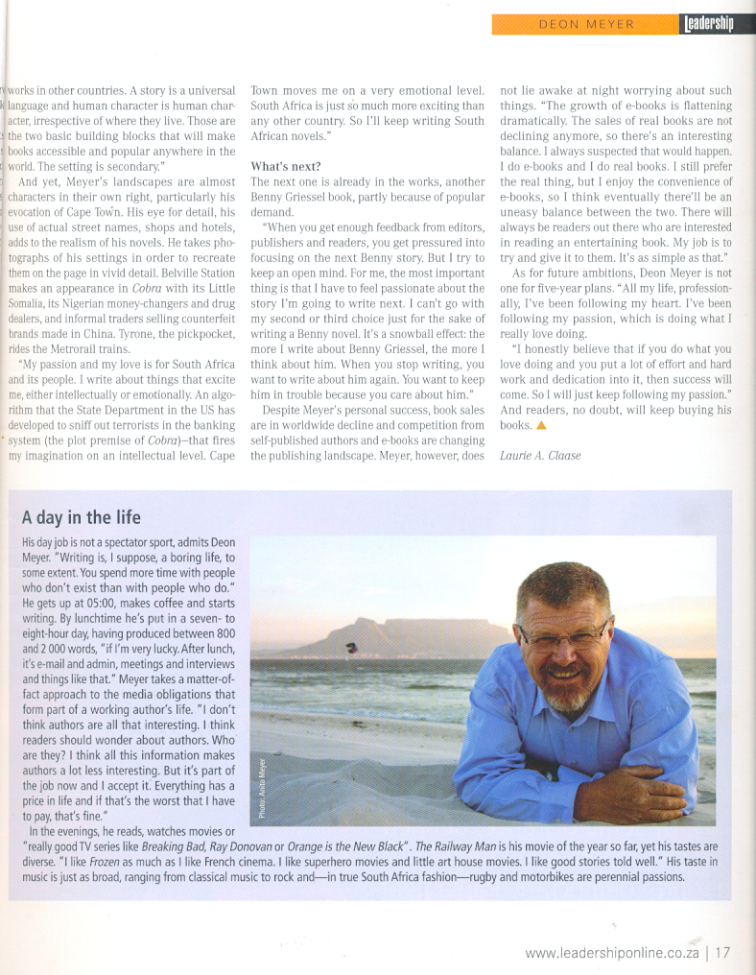
His day job is not a spectator sport, admits Deon Meyer. ‘Writing is, I suppose, a boring life, to some extent. You spend more time with people that don’t exist than with people that do.’ He gets up at 05:00, makes coffee and starts writing. By lunch time he’s put in a seven-to-eight-hour day, having produced between 800 and 2 000 words, ‘if I’m very lucky. After lunch, it’s e-mail and admin, meetings and interviews and things like that’. Meyer takes a matter-of-fact approach to the media obligations that form part of a working author’s life. ‘I don’t think authors are all that interesting. I think readers should wonder about authors. Who are they? I think all this information makes authors a lot less interesting. But it’s part of the job now and I accept it. Everything has a price in life and if that’s the worst that I have to pay, that’s fine.’
In the evenings, he reads, watches movies or ‘really good TV series like Breaking Bad, Ray Donovan, or Orange is the New Black. The Railway Man is his movie of the year so far, yet his tastes are diverse. ‘I like Frozen as much as I like French cinema. I like Superhero movies and little art house movies. I like good stories told well.’ His taste in music is just as broad, ranging from classical music to rock and – in true South Africa fashion – rugby and motorbikes are perennial passions.