

Yesterday’s Heroes | Leadership Magazine | May 2014
SOUTH AFRICA: On 7 April 2000, police in New Delhi charged Hansie Cronje and three other South African cricketers with criminal conspiracy. Fourteen years later, to the day, Oscar Pistorius took to the stand to defend himself on charges of murder and gun-related offences. Both Cronje and Pistorius had been lauded as national heroes; both were brought low by their own flaws of character and both prompted South Africa to search its collective soul and ask what is the true nature of heroism? (Publication: ‘Leadership Magazine’)
The word hero comes from the Greek, and has its roots in war. A hero was originally a brave fighting man, willing to sacrifice himself for the greater good of all. Later, the term took on moral attributes and became entwined with the concepts of ‘…quest and adventure, of trial by ordeal, of initiation, of peril and rescue and of triumphant return’ as Garry Whannel put it in his 2002 book Media Sports Stars – Masculinities and Moralities.
Today the sports field has adopted the heroic rhetoric of the battlefield. With sport now a global spectacle, the media plays a significant role in shaping both our perceptions, and our morality. Sports stars are idolised unquestioningly, and not only in South Africa. The cult of celebrity sportsmen is widespread but what constitutes a worthy hero and role model? In the world of professional sport, winning is all. As US psychiatrist Dr Andrew Hodges pointed out, in his 2013 online article on the ‘Blade Runner’, such competition ‘requires tremendous assertiveness, a trait closely associated with primitive aggression and the “killer instinct”.’
And in the name of patriotism and pride, sponsorships and TV deals, these become the virtues of a sports star and we label them heroic. Fuelling this hyper-masculine world of testosterone, tattoos and trophies are the spectators, the media, and the authorities, who all enthusiastically go along for the ride. Sports celebrities are entitled to act as demi-gods, for this is how we treat them. Why then, are we so shocked at their fall?
Until Oscar Pistorius came along, Hansie Cronje had been one of South Africa’s most famous sporting heroes. Clean-cut and god-fearing – remember his What Would Jesus Do bracelet? – he epitomised the fresh face of cricket in the newly branded Rainbow Nation and led South Africa back onto the world sporting stage.
Adrian Hadland was the political editor of the Sunday Independent at the time Hansiegate broke. He explained South Africa’s sense of betrayal: ‘So much rested on Hansie Cronje; more perhaps than we realised. Like Francois Pienaar (captain of South Africa’s victorius World Cup rugby team in 1995), he personified what we thought the new South Africa was about. Like our Rainbow Nation, he persevered in the face of adversity and triumphed when those all around him had given up hope.’ So too did Oscar Pistorius, another clean-cut, God-fearing sporting hero, spectacularly overcoming his disability to compete against Olympic athletes.
In a nation searching for heroes and good news stories, both Cronje and later Pistorius became emblematic of South Africa’s own triumph over the evils of apartheid. Vicariously, through their achievements on the cricket ground and athletics track, South Africans could claim ourselves winners, no longer the pariahs of the western world. This myth was shattered by allegations of wilful corruption and murderous intent. South Africa was forced to confront once again what a fallen sporting idol meant for us as a nation. Justice Malala, writing for the Guardian reflected: ‘Pistorius would redeem us. He ran his guts out, and did. Now he is fallen, and we are lost.’
Yet, in truth, and elegies aside, the two men’s disgrace shows simply that they are no different from any other South African who lives beyond the law; who cheats, lies or kills. However, unlike ordinary citizens, the objects of our adulation live in a self-idolatrous world of entitlement and impunity, pushing the boundaries until their behavior becomes so extreme that we can no longer turn a blind eye.
While Oscar Pistorius’s trial has overshadowed the others, there have been a number of high-profile murder cases involving sports celebrities, which have made both local and international newspaper headlines over the past two years. Take, for example, the murder-suicide of American footballer Jovan Belcher and the murder charge against another American footballer, Aaron Hernandez.
On 1 December 2012, after an argument with Kasandra Perkins, his 22-year-old girlfriend and mother of their 3-month old baby, Jovan Belcher shot Kasandra 9 times in front of his mother. He then drove to his training grounds and shot himself.
On 22 August 2013, in the same week that Oscar Pistorius received his murder indictment, in the United States, football player Aaron Hernandez was indicted for murder, accused of the shooting of his friend Odin Lloyd. Hernandez was also being investigated for a 2012 double homicide in Boston where shots were fired into a car. He was also being sued for an alleged injury relating to another shooting incident. Unlike Oscar, Hernandez didn’t get bail and is awaiting trial.
Such violence is not confined to professional sport. A year before the murder indictments served on Hernandez and Pistorius, on 11 August 2012, an intoxicated, 16-year-old Ohio schoolgirl was raped by two high school football players in front of friends who took pictures, which were posted to social media. Five adults were also indicted on a variety of charges including: obstructing justice, tampering with evidence, and failing to report possible child abuse.
Ma’lik Richmond and Trent Mays were tried as minors, and in March 2013 were convicted of rape. They were handed minimum sentences in juvenile detention: two years for May and one year for Richmond, who was released in January 2014 after serving less than the full year. Richmond must, however, register as a sex offender every 6 months for the next 20 years.
Even when celebrity offenders are finally charged, the sentences handed down for criminal convictions seem disproportionate to the seriousness of their crimes.
Take the case of South African soccer player Bryce Moon. He was charged with murder, attempted murder, reckless and negligent driving, and driving under the influence, after the Mercedes Benz he was driving collided with a pedestrian in the early hours of June 2009. Zimbabwean domestic worker, Mavis Ncube, was fatally injured.
Almost four years later, Magistrate Vincent Pienaar found that Moon had lied to the court. He had been speeding and had disregarded the rules of the road. However, the State failed to prove its case and Moon was acquitted of all the initial charges, including reckless and negligent driving. The magistrate found him guilt of culpable homicide and Moon was fined R60 000 or two years’ imprisonment. The magistrate said that ‘correctional supervision would be too harsh a sentence to impose because of Moon’s career as a professional football player,’ reported The Star. The victim’s father, Tinas Mpofu, was in court to hear sentencing. His take: ‘If you have money, you have the licence to kill in South Africa. What is R60 000?’ Moon is appealing the verdict.
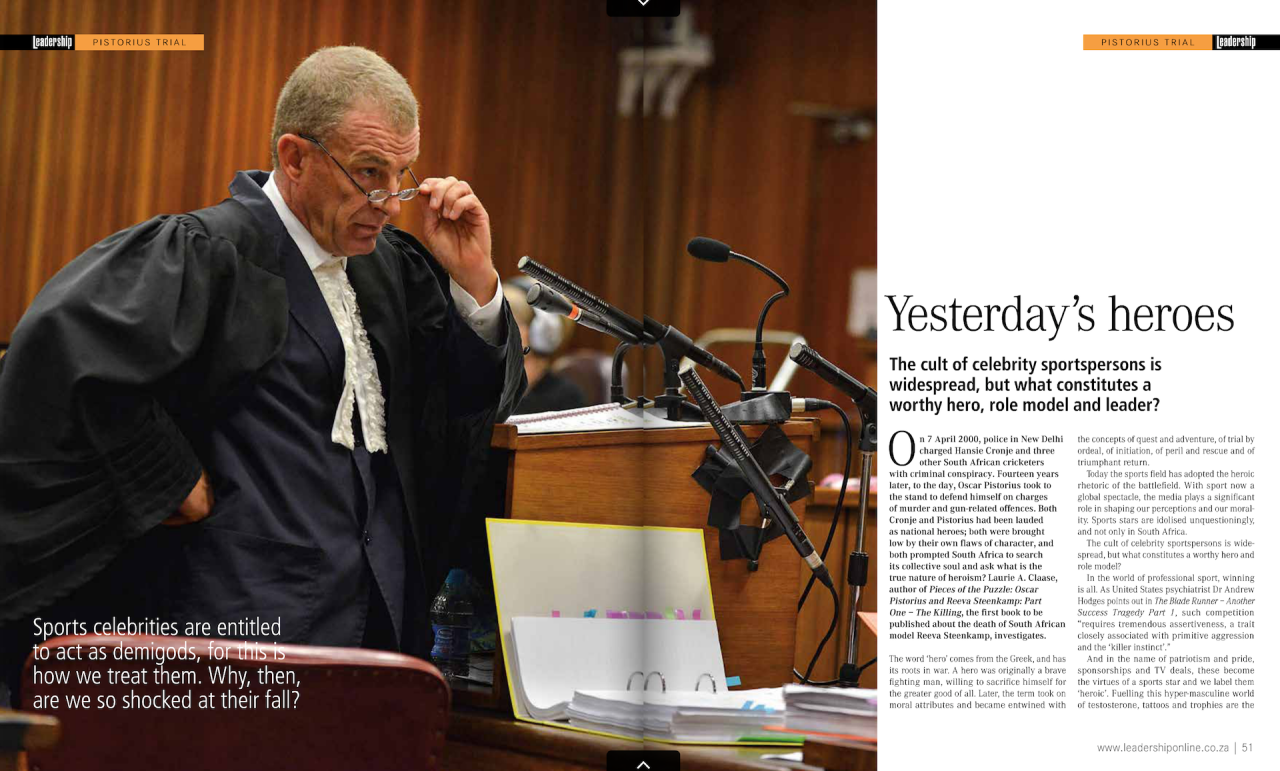
Fourteen years after the fall of Hansie Cronje, South Africa is once again interrogating the true nature of heroism. State Prosecutor Gerrie Nel began his much-anticipated cross-examination of Oscar Pistorius thus: ‘You are one of the most recognized faces in the world. You are a model for able and disabled sportsmen the world over. ‘You know people look up to you as a sports hero.’
As Gerrie Nel’s merciless questioning revealed a man of overweening ego, unwilling to take responsibility for any of his actions, the Twittersphere tolled the fall of Oscar and the rise of Nel.
@Taryn4444 – ‘He was my hero but now not anymore’
@ladysadiha – ‘I am #teamNel all the way. #GerrieNel is representing the truth, #Reeva, her family and the country. #OscarPistorius #OscarTrial
And herein, I think, lies the qualities of true heroism: a commitment to truth, a desire for justice, and a selfless pursuit of the greater good. Thus, Gerrie Nel is identified as a hero – his job to find the truth and ensure justice is done. We see him fulfilling his role with a deep-seated moral conviction. The ear witnesses too, are heroes by this definition. They testified for the State at considerable personal cost, sacrificing their privacy and enduring intimidation to do their civic duty. Oscar’s defence attorney, Barry Roux, ‘inadvertently’ read out Charl Johnson’s cell phone number in open court. He was inundated by calls from the media and vindictive voice mails. His wife Michelle Burger was the State’s first witness. eNCA mistakenly broadcast her image. Roux kept her on the stand for two days under cross-examination but her account of a woman’s ‘terrible screams’ remained unshakeable. ‘Michelle Burger is a hero. Reeva has a voice today, #OscarTrial’ tweeted @Johnaseth.
Then, there was Oscar’s ex-girlfriend Samantha Taylor, who conducted herself with quiet dignity – and some distress – on the witness stand as she deftly evaded Barry Roux’s traps. Aislinn Laing of the UK’s Daily Telegraph observed that as Taylor gave evidence ‘My twitter feed filled with some very nasty and unnecessary comments from die-hard Pistorius fans…’
While Pistorius insisted that he never screamed at Reeva or Samantha Taylor he did admit to screaming at a friend of Samantha Taylor’s who was ‘drunk and disorderly’ at a party. This is probably a reference to Cassidy Taylor-Memmory who laid a charge of assault against Oscar, which was not pursued by the authorities. She lodged a civil claim against him to recoup her legal fees. Oscar finally settled this claim in December 2013. However, Taylor-Memmory never received an apology for the injury to her leg, caused she said by a ‘furious’ Oscar punching a door so hard that one of the panels shattered. Cassidy told EWN’s Mandy Wiener that she had received hate mail for standing up for herself and needed a bodyguard to go out in public but ‘I’m proud of the fact that I never backed down and I learned that you should always stand up for what is right, even when you stand alone.’
With the fallout of the Public Prosecutor’s report on Nkandla continuing against the background of the Pistorius trial, people were quick to draw comparisons between Oscar and Jacob Zuma’s reluctance to accept responsibility. There were calls for Zuma to be prosecuted as vigorously. This dearth of political leadership prompted Jon Foster-Pedley of the Henley Business School to encourage ordinary South Africans to respond to a ‘Call to Heroism’ and help transform South Africa for the benefit of all her people.
‘I’m talking about a quiet, inner heroism and integrity where people are not corrupting themselves by over-indulging, but rather committing to educating and developing themselves, believing in their own vast potential and abilities.’
There is a new wave of media-driven campaigns that highlight these kinds of heroic qualities: eNCA and eTV’s South African Heroes slot, Primedia’s Lead South Africa radio initiative and CNN’s Hero of the Year Award all showcase ordinary people making an extraordinary difference in their communities. South Africans go to the polls in May this year, with the death of Nelson Mandela a timeous reminder of the nature of true heroism. If the Oscar Pistorius story teaches us nothing more than to choose our heroes and our leaders wisely, then Reeva Steenkamp’s death will not have been in vain.