

Iquitos is Peru’s northernmost city. With half-a-million inhabitants, Peru’s sixth most populous city is also the largest city in the world inaccessible by road. Other than flying, the only other way to get here is by boat. This frontier town is the gateway to the Upper Amazon River. The tree-lined Malecón of Iquitos pulses with pedestrians, while the Itaya River meanders through the fecund floodplains below. The ubiquitous tuk-tuks are a muted roar. The Amazon River once flowed past here, slowly clawing back its banks from the swelling city, prompting human intervention to divert its destructive course a few kilometres distant.
Peru is home to 16% of the Amazon biome. Amazon. The word alone conjures up images of hidden tribes and impenetrable jungle, flesh-eating fish, man-eating snakes and things that go bump in the night. The reality, however, would prove to be somewhat more prosaic – if no less exotic.
Our destination was Otorongo Lodge, 87 kilometres and a two-and-a-half-hour speedboat ride from Iquitos, on the Rio Oran, one of a thousand main tributaries. The rustic 12-bed eco-lodge is at the start of the main branch of the Amazon River where the two largest tributaries – the Marañón and the Ucayali – empty themselves into the longest river in the world.
It was the beginning of November and the end of the low season. There is no wet or dry season in the rainforest. It is a matter of degree. Nor is there much of a difference in temperature. It’s hot. However, when the snow begins to melt in the Andes at the end of November, the floods come. The river can rise by as much as 4 metres by the time high-water season peaks in June, opening up the primary forest to canoes. In the low season, however, one can walk in the rainforest, and fishing is at its best. Each season has its unique attractions.
Otorongo’s greatest appeal, despite solar-powered electricity, three meals a day, a steady supply of yucca biscuits and no shortage of cold beer, is having your own personal guide. Christian Silva, our English-speaking guide, grew up in Nazaria village, across the river from the lodge. His uncle and his grandfather were shamans. He recalled how his grandfather would serve the family anaconda for lunch. Christopher, our local guide, was from the neighbouring village of Oran. They accompanied us on day and night walks, boat rides and bush braais, fishing and birding excursions and a visit to Christian’s cousins in his home village across the water.
In Peru, the protected areas of primary forest begin a kilometre inland from the riverbank. Remnants of the cloud-scrapers remain. Two species of ancient kapok trees are a boat ride and short walk from the lodge. Felled to use as plywood and veneer, some of these towering trees were spared the fate of the mahoganies, whose lofty crowns were identified by loggers flying over the canopy. The Peruvian mahoganies are all but gone now but the kapok trees remain, sacred to the Mayans of Mexico and the local indigenous tribe, the Yaguas, whose young women camp at the kapok tree upon their first menstruation.
Everything in the forest seems to have a story and a use. There’s the justice tree, which is protected by fire ants that feed on the flowers. They crop the grass around the tree to prevent herbivores from grazing, thus protecting themselves from competition. The ants’ fiery sting made them the punishment of choice of the early-20th-century rubber barons who would use them on the indigenous labourers.
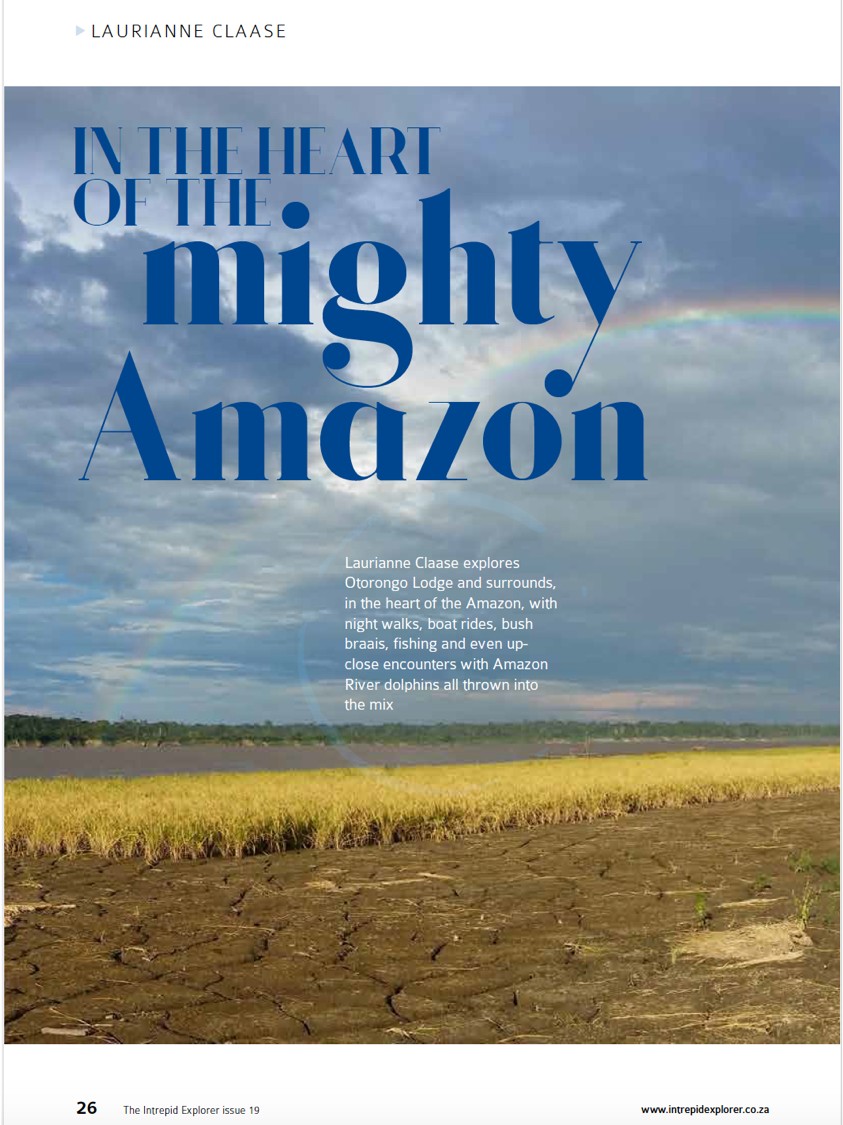
The riverbanks are a patchwork of secondary forest and cultivated clearings. Along the river’s edge, in the short growing season before the floodwaters come, villagers plant yucca, bananas and pineapples and use the shifting islands as rice paddies. Crowing roosters vie with the chatter of parrots and the call of the monkey-hunting crane hawk. In high-water season, the chickens are berthed on floating platforms and the pigs are moved to dry ground, to which the terrestrial animals of the forest also retreat. Local hunters keep the location of these patches of terra firme a closely guarded secret, so as to profit from the knowledge come the killing season.
Seasonally flooded forests make arboreal adaptations a necessity, giving rise to tree frogs and tree-nesting termites, tree-climbing porcupines, anteaters with prehensile tails and cork-headed ants, which flatten their heads to use as parachutes should they fall from the tree canopy where they make their home. The pygmy marmoset lives in these trees. Weighing in at just 120-150g when fully grown, it is the smallest monkey in the world. An adult pink-toed tarantula at its full 25cm stretch is as big.
Over 200 tree species per hectare have been recorded in parts of the Upper Amazon. The river boasts 2 500 marine animals, including turtles and 27 species of catfish. In the area around the lodge there are 17 species of palm alone; 2 species of sloth – one of which can swim – who feed from 60 kinds of trees. But the star attraction on this stretch of the river is the Amazon River dolphin.
Pink dolphins are actually freshwater whales as they have a hump, not a dorsal fin. When the males get excited the capillaries pump more blood, causing the distinctive pink colour. About a thousand make their home here and are reliably seen during the low season. Local legend has it that the dolphins were once Vikings, saved from a watery death by the god of the river after the chief’s daughter fell in love with one of them. Thus, the dolphins are not hunted and women don’t swim in this part of the river lest they fall pregnant. Curious creatures, they emerged when Christian tapped on the side of the boat with a paddle, affording us tantalising glimpses of their sleek, silvery shapes.
We trekked to Ladybug Lake, which is flooded in the high season, to flush hoatzin birds out of the palms. Prehistoric living fossils whose 13 million-year-old-bones have been found in Europe, they are not good flyers. To compensate, they emit foul-smelling pheromones to deter predators. When nervous, their grey eye masks turn blue.
Night on the river is an unforgettable experience. The waters boil with fish. They land in the boat, in your lap and on your head. The air thrums with fishing bats scooping up the minnows that teem on the surface. Nocturnal birds hunt the insects that swarm in clouds above the water and the chorus of frogs from the floating waterweed is deafening. We got up close and personal with the triangle bark tree frog, the pygmy hatched-faced frog and the schizophrenic polka-dot tree frog, which changes its colour from day to night. In the high season, you can go by boat to Ladybug Lake. In the low season, we could only go so far before running aground. The indigenous Brazilian Tupi tribe believed that the Amazon River was formed from the moon’s tears after her doomed love affair with the sun. As we turned back, the new moon flashed a thin-lipped smile low in the sky. And the river rolled by …