
Independent travel has changed in the last 25 years. Poste restante and pay phones, travel books and travellers’ cheques have given way to WhatsApp and smart phones, websites and digital wallets. Word-of-mouth is now by wi-fi. We’d never had it so good. We had a better-padded bank balance than back in the day. But, at the time, the rand was 14 to the dollar and the cost of living in each country was an unknown factor. We had to budget – one of the time-honoured tenets of the backpackers’ bible – along with:
- Thou shalt travel light;
- Thou shalt not cleave to planned itineraries; and
- Thou shalt go among the local people.
We estimated a budget of $100 a day for 2, excluding flights, downloaded TrailWallet, an app that allows you to capture every expense and whittled our packing down to one carry-on bag each. Admittedly, we strayed from the true path, and pre-booked flights and accommodation for the first three weeks but thereafter we made our way – on public transport mostly – from south to north, staying with local hosts in AirBnBs and pensiones, and tracking the Pacific coast.
Argentina
At the start of September, after 21 hours in transit via Sao Paulo in Brazil, we touched down in Buenos Aires, the tango capital of the continent. On any given night, whatever the neighbourhood, you’ll find a milonga. While the rest of the week night world slumps in front of the TV, here, women slip on their heels and men don their cravats to congregate in social clubs across the city. With old-world etiquette, the men cross the room to invite the women to dance, and they glide and dip, sweep and fall to recordings of scratchy violins and long-dead crooners.
As much as their milongas, ‘the people of the port’(porteños) enjoy their meat and their mate. This is no place for vegetarians unless you’re prepared to live on yerba mate, the herbal tea with a caffeine kick. The locals never leave home without their gourd-like flask (guampa) and steel straw (bombadilla). Much like the rest of Latin American, Argentinians also love their dogs – but not cleaning up after them. We had to watch our step.
A distinctly European city of crumbling grandeur and contemporary flair, four days were too few to sample its many delights. But we tried. We attended mass at the Metropolitan Cathedral, where the current Pope was once Archbishop, and the ballet at the sumptuous Teatro Colon. We wandered in the rain through a stone city of the dead, to find Evita Peron’s burial place in the Recoleta Cemetery, and visited the museum to Argentina’s unofficial patron saint.
Uruguay
From Argentina to Uruguay in an hour, by high-speed ferry, across a river they call ‘the sea.’ Some 200 kilometres across at its broadest, the Rio de la Plata is the widest estuary in the world. We disembarked to stone walls, cobbled streets and tree roots pushing up the paving. Colonia del Sacramento is one of the oldest towns in Uruguay, dating back to 1680. The low, clay-roofed buildings, the 18th- century fort and 19th-century basilica reflect the town’s Portuguese roots.
A two-and-a-half hour bus ride brought us to the capital, Montevideo. 19th- century Italianate palacios, art deco mansions and post-modern skyscrapers edge the palm-lined plazas and parks where food trucks ply a busy trade. Uruguayans enjoy free health care and free education, and gay marriage is legal, as is marijuana. “Don’t tell the USA,” quipped our walking tour guide.
While Catholicism is the dominant religion of Latin America, football is the one true faith. We bought our tickets for a local city derby at the stadium where Uruguay won the first FIFA World Cup in 1930 and joined the yellow-and-black throng of Peñarol fans at their home ground. It was a family affair. Fathers, their biceps proudly tattooed in the team logo, held aloft babies swaddled in the team strip. Amid yellow smoke and billowing banners, we ate churros out of paper bags, shared mate with our neighbours and were swept up in the rousing singing from the stands.
Chile
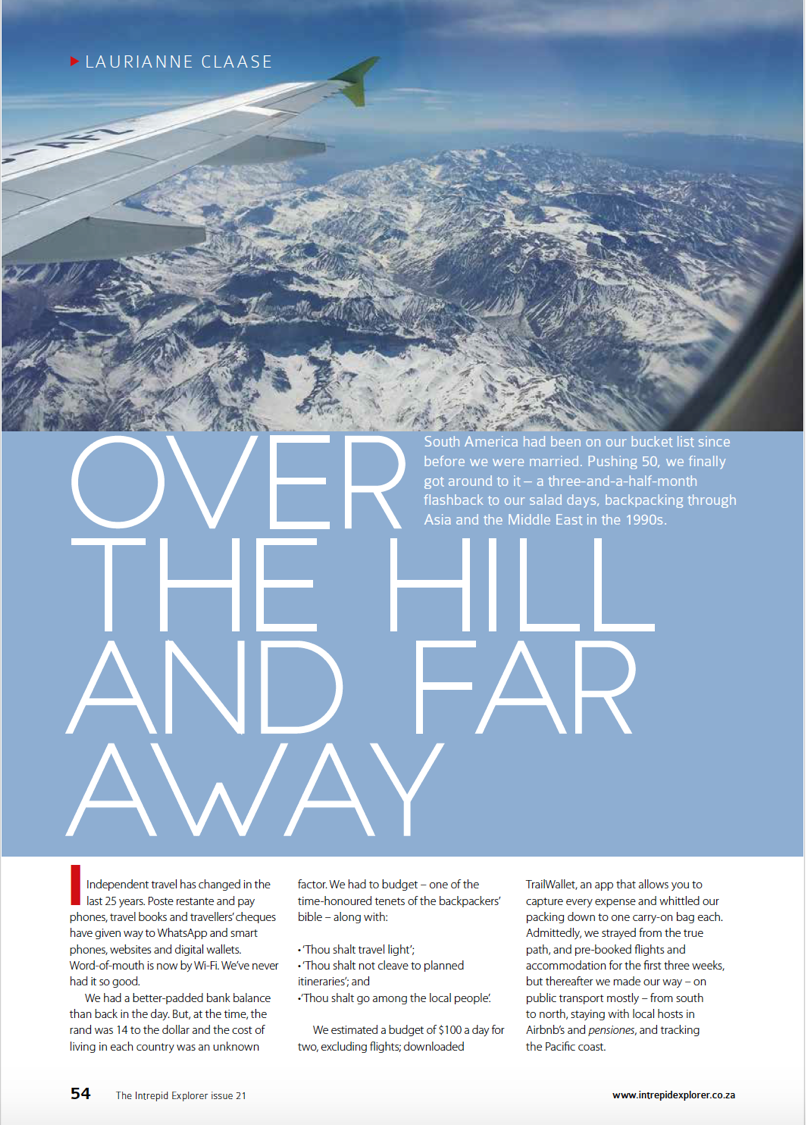
From the lake-studded south with its ski-slope volcanoes to the sun-seared deserts and surfing hot-spots of the north, Chile proved to be a country of contrasts. Landing in the capital Santiago, the plane erupted in applause at our successful crossing of the longest continental mountain range in the world. The Central Andes ends in southern Chile, which is where we finally touched down.
The Lake District is the Bavaria of Latin America. Glacial lakes and snow-cone volcanoes frame fertile farmland, well-fed cows, and Lutheran churches, thanks to the influence of 19th-century Germanic settlers. Gnomes are big here, as are kuchen, marmalade and pork. In Puerto Varas, my fish calzado (stew/soup) came with sausage and smoked ribs. The seafood of the south is a gastronomic delight. At the Puerto Montt fish market, in a little hole-in-the-wall restaurant, designated by a number rather than a name, our seafood platter came with abalone.
With their love of dogs, music, colour and art, Chileans are the hippies of the continent. They’re also the most jingoistic. We found ourselves in Santiago for the annual independence celebrations and joined the holiday crowds for the Day of the Glories of the Army parade. Patriotic Chileans queued to take selfies with their soldiers, their kids decked out in the red, white and blue of the national flag.
We bused on, heading north toward Peru through the Atacama Desert, littered in colonial ruins and copper mines, the desiccated graveyards of 19th-century nitrate miners and pre-Colombian geoglyphs carved into the hills of the driest desert on earth.
Peru
Peru has its ups and downs. Literally. From coastal desert and Amazon rainforest to the high Andean plateau (altiplano), you can travel from sea level to over 4 000 metres in a single day. And we did. Fortunately, altitude did not present a problem but Peruvian buses are not for the faint-hearted. These are some of the highest roads in the world: at times, single lane – and often gravel – with precipitous drop-offs, changeable weather and fatalistic drivers. On one particularly hairy ride, the four-man bus crew had to rebuild a section of the road before we could pass. Eyeing the Marignon River some 3 kilometres below my window, I was ready to walk.
Taking a sho’t left from the Gringo Trail, we didn’t join the Machu Picchu crowds. Instead, we had Kuelap all to ourselves. The pre-Inca fortress in the northern cloud forests of the Chachapoyas is set to rival Peru’s greatest tourist attraction, with the completion of the country’s first cable car. We explored Arequipa, dubbed the white city, not for the three snow-covered volcanoes that surround it but for some of the finest Spanish colonial architecture outside of Cuzco, intricately carved from white volcanic rock. We got carpal tunnel syndrome from photographing the 437-year-old convent of Santa Catalina, slurped pisco sours and sampled the local Andean delicacies of alpaca steak and deep-fried guinea pig. We stayed with a Quecha Indian family on the shores of Lake Titicaca, the highest navigable lake in the world; visited the 5 000-year-old desert ruins of Caral; ascended the foothills of the Cordillera Blanca, the highest tropical mountain range in the world and walked in Amazon rainforests that spend half the year under water.
Colombia
After a week on the Peruvian Amazon River, we rendezvoused with a passing fast boat. Eight hours later, we arrived in the Colombian border town of Leticia, where Brazil, Peru and Colombia meet. Thence, by air, to Bogota, the gritty, vibrant capital city, shrouded in cloud and surrounded by cloud forests.
Colombia has five distinct regions, encompassing the Andes, the Amazon, the Plains of Orinoco and the Caribbean and Pacific coasts. After two months on the road, we opted for some down time and settled on the Caribbean coast and islands. At the end of the rainy season, Tayrona National Park was hot, wet and muddy. Howler monkeys greeted the dawn, caimans slumbered in cool lagoons, and heaving seas sheltered coral reefs of tropical fish. We walked the ancient walls of Cartagena, heavily fortified against pirates because it was from here that the precious metals plundered from the New World were stored before being shipped to Spain. The picture-perfect old city is set against a backdrop of modern skyscrapers, apparently built on money laundered from cocaine.
Some 850 kilometres off the northern Colombian coast lies the island of Providencia, our first – and only – English-speaking destination. Many of the locals are the Jamaican descendants of African slaves, imported by the British to cultivate tobacco and cotton. The original pirates of the Caribbean also called this home. We could see why – warm sea, palm-fringed beaches, crab and crayfish fresh off the boat and reggae vibes. Irie, mon.
Cuba
Back in Bogota, we boarded our flight to Havana, 18 hours after Fidel Castro died. Nine days of mourning put Havana’s celebrated nightlife on hold and Cuba’s fabled cocktails were hard to come by. The ban didn’t seem to apply to state-run entities however. The landmark Hotel Nacional, once home to the mafia consortium that had run Cuba before the revolution, and now a national monument run by the State, was selling bottled beer for a cool R60 and Cuban cigars for R150. I couldn’t help but wonder if Fidel was turning in his grave.
While still stuck in a communist past of crumbling infrastructure, queues and shortages, Cuba is also catching up with the 21st century. Access to wi-fi has come in the last 18 months; private ownership of property and limited private enterprise is permitted, gay rights have been recognised, travel restrictions eased, and artistic expression is emerging after a long hibernation. Travel is easy, accommodation ample and comfortable, the food abundant, the cigars smooth, the classic cars cool and the cocktails – eventually – free-flowing. We’ll be back, we said. And we were. But that’s a story for another day.