
Madagascar
I’ve set foot on some of the Indian Ocean’s ‘relatively few islands’ – Zanzibar, Mauritius, and Mozambique’s Bazaruto Archipelago – but not the island on my doorstep – the world’s fourth-largest (587 295 km²) and perhaps the oldest.
Part of the ancient supercontinent of Gondwana, Madagascar separated – first from Africa and then India – between 175 and 88 million years ago and remained isolated for millions more. The island became a Noah’s Ark. ‘Approximately 95 percent of Madagascar’s reptiles, 89 percent of its plant life, and 92 percent of its mammals exist nowhere else on Earth.’ It was one of the last landmasses to be inhabited –less than 2 000 years ago – by Malay-Indonesian seafarers, East African migrants, Arab traders, South Indian merchants, French Catholic missionaries and Chinese immigrants, before 19th century colonisation by the French and, finally, independence in 1960.
Who arrived first – the Africans or the Austronesians – is still a matter of debate. One theory has it that the first settlers may have been a group of 30 women – possibly refugees – from southern Borneo, who were shipwrecked around 1 200 years ago. These Iron Age Eves bequeathed Madagascar its lingua franca, long before the arrival of the French. While most closely related to Ma´anjan, a dialect of southwest Borneo, the Malagasy language has 300 Sanskrit words, as well as Arabic, Swahili and Malay, reflecting a lost continent reunited with its people, if not its tectonic plates.
So where to begin exploring the diversity of an island half the size of South Africa? Heeding the late Archbishop Tutu’s advice that “there is only one way to eat an elephant: a bite at a time”, I decided to start small, with the other ‘Big Island’.
Nosy Be Archipelago
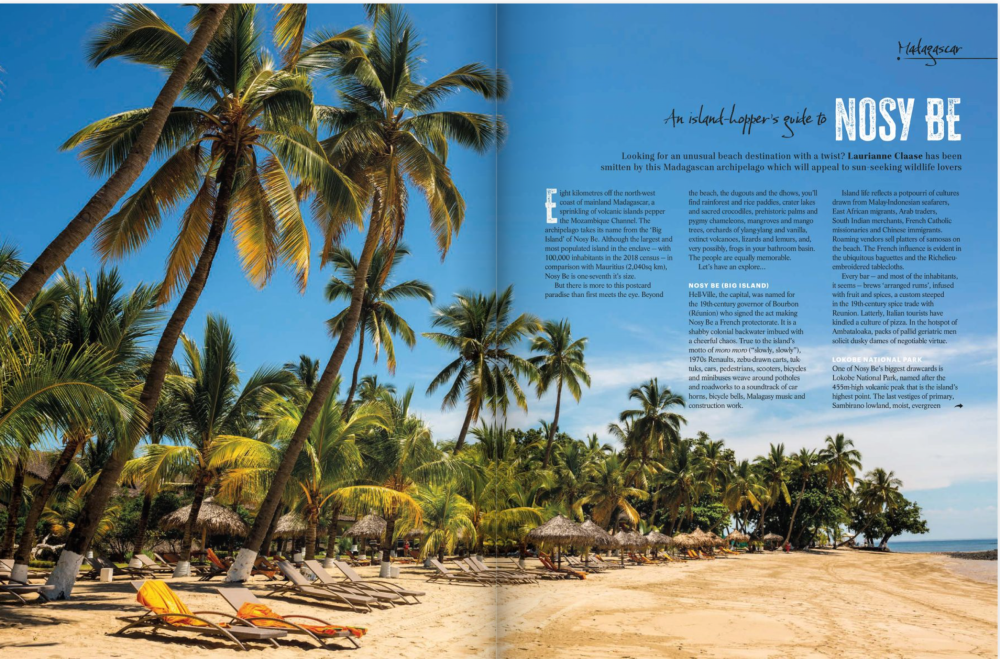
Eight kilometres off the north-west coast of mainland Madagascar, a sprinkling of volcanic islands pepper the Mozambique Channel. The archipelago takes its name from the ‘Big Island’ of Nosy Be. Although the largest and most populated island in the archipelago – with 100 000 inhabitants in the 2018 census – in comparison with Mauritius (2 040 km²), Nosy Be is one-seventh it’s size (310 km2). There is more to this postcard paradise than first meets the eye. Beyond the beach, the dugouts and the dhows, you’ll find rainforest and rice paddies, crater lakes and sacred crocodiles, prehistoric palms and pygmy chameleons, mangroves and mango trees, orchards of ylang-ylang and vanilla, extinct volcanoes, lizards and lemurs, and, very possibly, frogs in your bathroom basin. The people are equally memorable.
Nosy Be (Big Island)
There is evidence of human occupation as early as the 8th century. The first migrants from the mainland – who knew the island as ‘Vario Be’ – were joined by East African and Comorian immigrants. Arab traders introduced Islam to the island as early as the 9th century. Islamic merchants from the Gujarat province of western India arrived in the 15th century on ‘small sailing boats’ and set up shop on Nosy Be where the first mosque in Madagascar was built around 1700. Sheltered by the bay of Ampasindava, Nosy Be became an important port and trading centre for turtle shells, gold, spices and slaves.
By the end of the 18th century, the Sakalava people of the west coast had brought almost half of Madagascar under their control by trading slaves and cattle for guns with Omani Arabs and Europeans, until they were challenged by the Merina in the 1830s. Queen Tsiomeko sought refuge on Nosy Be and turned to the French to ward off her rivals. Nosy Be became a French protectorate from 1840 until 1896 when it was returned to Madagascar. It gained independence along with the rest of the country in 1960.
Hell-Ville, the capital was named for the 19th-century governor of Bourbon (Reunion) who signed the act making Nosy Be a French protectorate. It is a shabby colonial backwater imbued with a cheerful chaos. True to the island’s motto of moro moro (‘slowly, slowly’), 1970s Renaults, zebu-drawn carts, tuk-tuks, cars, pedestrians, scooters, bicycles and minibuses weave around the potholes and the roadworks to a soundtrack of car horns and bicycle bells, Malagasy music and construction.
Island life reflects a potpourri of cultures drawn from Malay-Indonesian seafarers, East African migrants, Arab traders, South Indian merchants, French Catholic missionaries and Chinese immigrants. Roaming vendors sell platters of samoosas on the beach, and rice is eaten with every meal. The French influence is most evident in the ubiquitous baguettes and the Richelieu-embroidered tablecloths – a medieval style of cutwork lace whitework popularised in France in the 17th century and named after its most famous Cardinal. Every bar – and most of the island’s inhabitants, it seems – brews ‘arranged rums’, infused with fruit and spices, a custom steeped in the 18th to 19th-century spice trade between Reunion and Madagascar. Latterly, Italian tourists have kindled a culture of pizza. Sex tourism is also on the menu. In the hotspot of Ambataloaka, packs of pallid geriatric men, in a Saturday-night fever, solicit dusky dames of negotiable virtue.
North of Ambataloaka, the tourist beaches give way to fishing villages and deserted resorts, in varying states of completion or collapse. Unlike Cape Town, tourism has not recovered from lockdowns. One of the poorest countries in the world, Madagascar ranked 173 out of 190 countries on the UNDP’s Human Development Index in 2021. The Malagasy people, however, remain indefatigable.
At a beach bar consisting of two umbrellas and a wooden bench, I meet its proprietor, ‘AJ’, from southern Madagascar. After the death of his parents, he came to Nosy Be to make a new life for himself and his family. He failed his entrance exams for the gendarmerie multiple times because of corrupt officials, studied hospitality in Hell-ville, worked as a waiter, was offered a job in Poland but couldn’t afford the visa and survived the Covid era as a security guard. With the small profits from his latest venture, he pays off the police, as he can’t afford a licence, and saves what he can towards his expansion plans for coffee, juice and WiFi.
Lokobe National Park
One of Nosy Be’s biggest drawcards is Lokobe National Park, named after the 455 metre-high volcanic peak that is the island’s highest point. The last vestiges of primary, Sambirano lowland, moist, evergreen forest are preserved in this 740-hectare reserve, along with a marine sanctuary of 122 hectares. Lokobe is said to mean ‘many colours’ in Malagasy, perhaps in reference to the forest’s myriad shades of green. Wild vanilla vines climb outsize mango trees, and jackfruit hang in pendulous profusion. Tree boas (Sanzinia madagascariensis) mimic lianas, and leaf-tailed geckos (Uroplatus sikorae sameiti) perform Oscar-winning impressions of tree bark. Sleepy lemurs huddle in tree hollows. Of Madagascar’s 45 species of lemurs, Lokobe has three: the endangered black lemur (Eulemur macaco), the critically endangered Nosy Be sportive lemur (Lepilemur tymerlachson) and Claire’s mouse lemur (Microcebus mamiratra) – which aptly describes its size.
The nut of the endangered Ramy tree (Canarium madagascariense), is beloved of the lemurs, its yellow flower aromatic and its scented resin used for caulking canoes. Palms there are a-plenty, including endemics like the critically endangered Dypsis nossibensis and the Dypsis ampasindavae (‘Kindro’), which is only found in Lokobe. The distinctive Traveller’s Palm (Ravenala madagascariensis) is not really a palm tree at all but a Bird of Paradise. The leaf stalks are a welcome source of water for thirsty travellers, and its fronds are used to build the walls and roofs of traditional dwellings. Uncultivated ylang-ylang trees, brought to the island from the Philippines in the 1920s, soar into the canopy, spilling their scent to the wind and their perfumed flowers to the forest floor, where hognose snakes (Leioheterodon madagascariensis) hustle and terrestrial boas (Boa madagascariensis) rustle. The river beds and leaf litter shelter tiny Brown mantella frogs (Mantella betsileo) and the endemic, endangered, Andoany atump-toed frog (Stumpffia pygmaea) as well as the world’s second-smallest chameleon – the minute leaf/Nosy Be pygmy leaf (Brookesia minima).
All this and more, in a morning’s amble, thanks to the sharp eyes of Teodor, a young man from the local fishing village of Ampasipohy. With his schooling interrupted by school closures due to the government’s response to Covid-19, he took it upon himself to learn the Latin names of his forest’s fauna and flora. His dream is to attain a tour guide qualification but the cost is prohibitive.
From Nosy Be, the smaller islands and uninhabited islets, named for bats and birds, lemurs and the lovelorn, are easily accessible by boat. Fanned by palm-trees, and fringed in coral reef, the beaches beckon.
Nosy Komba (Lemur Island)
Three kilometres south-east of Nosy Be, Nosy Ambariovato (2 200 ha) is ‘the island surrounded by rocks’. However, it is better known as Nosy Komba for its population of sacred lemurs. The Malagasy have a long list of localised cultural taboos, and for the villagers of Nosy Komba, the black lemurs that share their dense, humid, evergreen-forested island are fady. Startled at first light by an unholy screeching, it dawned on me why my room was called ‘Maki’ – the Malagasy word for lemur. The troupe that inhabit the forest behind the bungalow had started their day in full throat at full swing.
Nosy Tanikely (Small Island)
The Marine Protected Area of Nosy Tanikely is 10 kilometres west of Nosy Komba and less than 30 minutes by speedboat. Although only 30 hectares (3.41 km2) in size, the islet’s cliffs, humid evergreen forest, beaches and fringing coral reef are home to 11 reptile, 89 plant and 13 bird species, 2 species of introduced lemur – the black as well as the common brown (Eulemur fulvus) – and the largest fruit bat, the Madagascan flying fox (Pteropus rufus). Uninhabited in the past by anyone other than the keeper of the lighthouse (1908) and his family, and distinguished by a fady on the presence of dogs and hogs – thought to be an edict from the Arabic era – Tanikely is one of Nosy Be’s most visited tourist attractions, although numbers are restricted. Just off the shady beach, kaleidoscopic coral shields rock cod and rainbow-coloured wrasse, red-knobbed starfish and sea turtles of the Loggerhead (Caretta caretta) and Green (Chelonia mydas) persuasion.
Nosy Sakatia (Orchids Island)
Nosy Sakatia (500 ha) lies some 750 metres off the west coast of Nosy Be. Known for its wild orchids, but named, some say, by a suitor thwarted by the landmass that lay in the way of his love, Sakatia is a mountainous island wrapped in humid evergreen forest and ribboned in coral. The fishing village of Ampasimena is the second largest after the town of Nosy Be. Off its beach, sea grass beds sustain giant sea turtles who are anything but shy. The Ambohibe Turtle Reserve is a community conservation project that protects the endangered Green and critically endangered Hawksbill sea turtle (Eretmochelys imbricata). Sakatia’s aquarium attracts divers and day trippers. The house reef is called the ‘swimming pool’ with good reason. At low tide, a short wade from the shore, lies a knee-deep underwater garden with iridescent rainbows of soft and hard coral, schools of technicolour fish and sea turtles so plentiful and placid that an inattentive snorkeler risks bumping into them. Lacking large predators or venomous reptiles, such are the perils of the Perfumed Isle.