

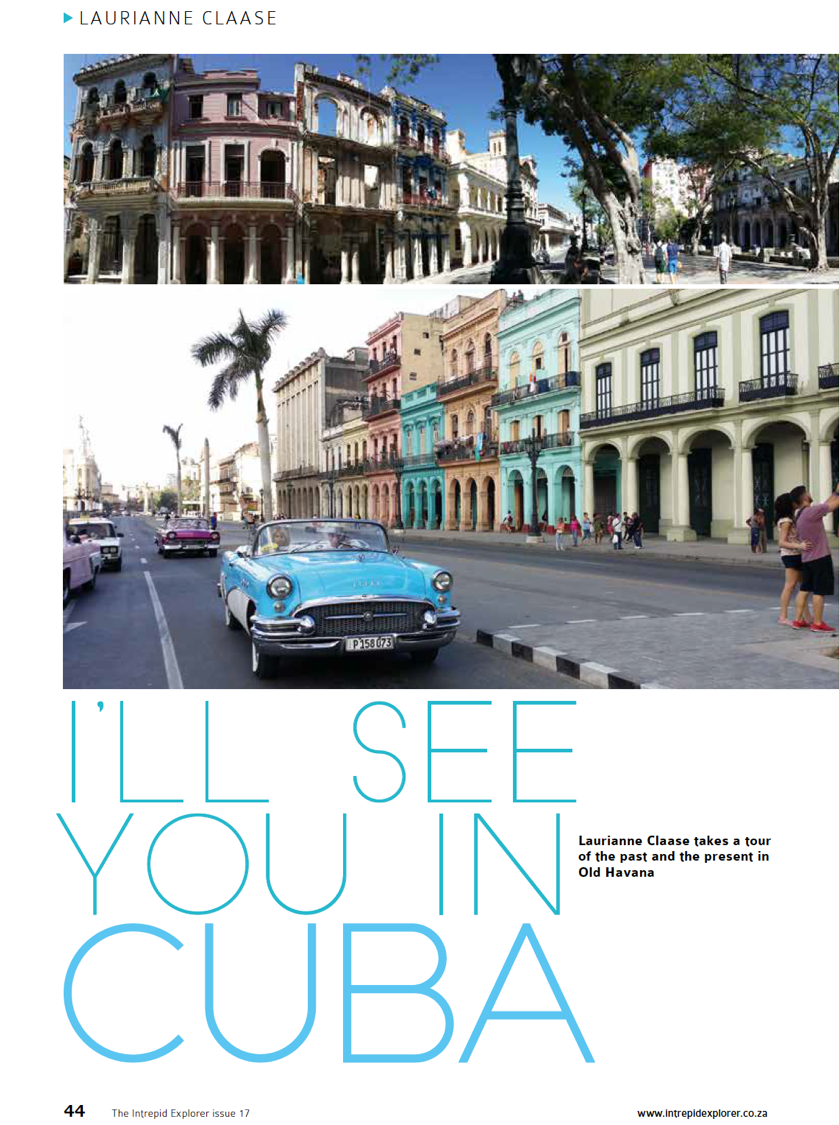
No totalitarian, humourless, grey Soviet-style communism, this. It’s a colourful, Catholic, rum-swilling, cigar-smoking, tropical island kind of communism that will give you carpal tunnel syndrome from all the camera-clicking. Expect the unexpected.
Cuba’s vibrant multi-racial population is a legacy of the island’s colourful past, peopled by pre-historic tribes and Spanish conquistadors, 19th-century sugar barons, African slaves and US mobsters, ruthless dictators and swashbuckling revolutionaries. This history has been preserved in crumbling concrete, thanks to the economic stagnation that followed the communist revolution of 1959.
Similarly, underdevelopment has rendered the island’s wetlands and mountains, coastline and coral seas largely untouched. Cuba is the largest – and least exploited – island in the Caribbean, and is home to nearly a third of all the coral reefs in the Caribbean. Few cars travel the countryside roads, which are given over to horse carts and bicycles, making Cuba a popular cycling destination as well as an eco-tourist’s paradise.
The home of the daiquiri, the mojito, and the piña colada, Cuba is also famous for its music: a jambalaya of West African and Spanish, Jamaican, American and French influences. Drumming and dancing go hand in hand with the music, giving rise to the rumba and the cha-cha, bolero and salsa, Cuban jazz, and a new age rap/hip hop mix called Timba.
Cuba’s architectural heritage encompasses some 500 years of history. Four cities have UNESCO world heritage status: Old Habana and her Renaissance fortifications, the 19th-century sugar town of Trinidad, French colonial Cienfuegos and Camagüey, one of the first seven villages founded by the Spanish in the early 1500s.
Havana, in particular, is a living museum to the last five centuries of European architecture, albeit vanishing at an alarming rate, due to neglect, densification and cyclones. Once known as the Paris of the Antilles, where movie stars and royalty came to party, today glamour and squalor exist side by side in a pastiche of candy-coloured classic cars and peeling pastel paint.
Old Havana (Habana Vieja) is the largest historic centre in Latin America. The 214-hectare heart of the old city, with its five large plazas, and eclectic mix of 16th- and 17th-century Baroque cathedrals, neo-classical and Moorish architecture is an enthralling mixture of urban decay and renewal. Old Havana and its 16th-century fortifications were recognised as a World Cultural Heritage by UNESCO in 1982. But there was neither the political will, the materials nor the money for repair. The bronze lions and marble benches, terrazzo tiles and wrought-iron streetlights of the 18th-century Prado Promenade are lined by arched colonnades. Like teeth lost in a fight, the graceful facades have gaping holes. From the street, glimpses reveal once imposing entrance halls ravaged by damp and time.
The 108 blocks of Habana Vieja is also the second densest part of the city. Some 80% of the houses in Old Havana were built after the 1900s and few have been renovated since the revolution. Abandoned by their owners, the buildings were handed over to the fighters and their families and subdivided. Increased migration from the rural areas led to more densification and decay.
Back in 2003, it was said of Old Havana that ‘two buildings collapse within three days’. This is no longer true as tourism dollars are now funding reconstruction of the Old City. The Hall of Mirrors, in the former Presidential Palace, which is today the Museum of the Revolution, is being restored and scaffolding surrounds the Capitolio. The former seat of government before the revolution, the grand edifice is reminiscent of the US Capitol in Washington DC but was apparently modelled on Paris’s Pantheon. The tourist zone in Habana Vieja grows with every passing year.
Havana’s iconic Malecon is an 8-kilometre-long esplanade, which runs along the sea wall from Old Havana and Centro to Vedado. In any capitalist country this would be prime waterfront property. In Havana, the once stately 19th-century homes and apartment buildings are slums. But a few have been rescued from ruin. At Castropol, you can sip a cocktail, puff on a R135 Cuban cigar, and watch the classic cars cruise the Malecon, as if the last 60 years never happened – but for the hose you have to step over that’s piping in potable water from the truck outside. However, the present is catching up with Cuba. People on park benches bend over their cell phones, connecting to a digital world they’ve been part of for only the last two years, although they cannot yet access the Internet from their homes.
Set aside at least two days to explore the Old City, not just because of the architecture, art and history, but because of the people you meet, like Felix Cepero, for example, aspirant Guinness World Book of Records holder for riding tall bikes. Smitten since first he saw a tandem cycle, Felix cobbles together his lofty bikes from the frames of Chinese Pigeons, ubiquitous during the depression years of the 1990s. He’s building his record-beating 10-metre-high bike with help from supportive tourists. With his outsized cycling exploits, in any capitalist country Felix would earn a good living from sponsorship and advertising. In Cuba, he and his wife sell sweets and beer from the doorway of their one-bedroom flat in Habana Vieja.
After inheriting the reins of power from his brother in 2008, Raul Castro loosened his grip on state control of the economy. At the time of writing, there were some 201 categories of jobs in the private sector. Cubans could buy and sell property, cars and electronic goods. Homeowners could rent out more than two rooms and employ people that aren’t family. This casa particulare business was booming, albeit heavily taxed. Cubans could frequent tourist establishments and travel abroad. However, most can’t afford to. State-owned enterprises still employ three-quarters of of Cuba’s work force. State employees earn, on average, between US$25 and US$40 a month and live on ration books.
Tourism is the big money-spinner, both for the government and the growing number of self-employed. This is because of Cuba’s dual currency system. In 1993, following the collapse of the Soviet Union, who had been propping up Cuba’s economy for decades, the US dollar was accepted as legal tender for tourism and international business transactions. The convertible peso (CUC), artificially pegged at 1 to 1 with the dollar, replaced the dollar in 2004. Tourists pay in CUCs. Cubans, on the other hand, use pesos cubano (CUP), at a rate also artificially set at CUP25 to the CUC.
The dual currency leads to two economies: those with CUCs and those with CUPs. If you earn CUCs you can shop at the Mall Habana and take private taxis. If you earn CUPs, you settle for what you can find at the under-stocked municipal markets; and queue to catch infrequent buses. Thus, molecular biologists work as taxi drivers, electrical engineers are tourist touts and lawyers and architects make a living renting out spare rooms in their apartments.
Idania, our casa particulare hostess in Vedado, studied law, English and Latin and worked for the government as a legal secretary. In a complaint that we heard more than once in our two-week stay, she bemoaned the low wages paid by the state. ‘If you work for the government for a month, you make enough to eat for a week,’ she said, ‘Never mind clothes or travel.’ There is little to buy in the state-run shops or municipal markets and Cubans are experts at la cola (the line).
On the other hand, Cuba’s adult literacy rate of 100% and its life expectancy of 79 years are the highest in Latin America. And in a nation founded by macho fighting men, homosexuality has been legal since 1979 and Cubans can undergo free transgender surgery on the national health system, thanks to the efforts of Raul Castro’s daughter, Mariela.
Eco-tourism
Underdevelopment, along with government conservation efforts, has also preserved Cuba’s natural environment. Less than 150 kilometres southeast of Havana, lies Baiha de Cochinos, the landing site of the ill-fated US-sponsored invasion of Cuba in 1961, better known in the West as the Bay of Pigs. At Playa Giron, a museum has all the details, including US weapons and a fighter plane captured from the enemy. Today the area attracts divers and snorkelers for its protected waters and 30 kilometres of pristine coral reef, easily accessible from the shore.
An air-conditioned shuttle bus runs along the low-lying coastline, and drops you off at reef-protected natural aquariums, such as Caleta Buena where you can lounge on deckchairs and indulge in the all-you-can-eat lunch buffet and open bar. At Cueva de los Peces (Cave of the Fishes), paddle out to explore the coral bombs in the shallow water or cross the road and snorkel the largest tectonic fault cave in Cuba, where seawater and freshwater mingle, as do the fish.
Then there’s the Zapata Peninsula, the largest, and most important wetland in the Caribbean, home to the endangered Cuban crocodile and a wealth of birdlife. We went out with Carlos, Giron’s resident bird expert, in his 1950s Willys jeep. Of the 26 endemics on the island, we saw 9 in a morning, including the smallest hummingbird in the world, zunzuncito, the ‘bee’.
In one of the world’s last planned economies, the army is in charge of tourism and they do it very well: from opulent 5-star hotels and all-inclusive packages, to state restaurants in restored colonial casas where along with your main, pastry, and coffee, you can enjoy a cocktail, a local beer and a digestive liquor. Yvette, our waitress, arrived with my Cuba Libre. ‘Tell me when to stop,’ she said, splashing Havana Club into my glass. However, because of the American embargo, in place since 19 October 1960, here, in the land of its birth, Cuba Libre doesn’t come with Coke.
The mythology of the revolution abounds in statues, memorials and museums, posters, books, T-shirts and even tattoos. The government milks it for all it is worth. The landmark Hotel Nacional is the ultimate symbol of the revolution’s victory over American decadence and imperialism. During the 1940s and 50s, North American money, socialites, celebrities, tourists and gangsters poured into Cuba’s hotels, casinos and nightclubs. Most of the landmark Habana hotels were built in the 1950s with US mob money. The Hotel Nacional was one of the finest in the mafia’s Havana portfolio. Built in 1930, the art deco/neo-classical building was modelled on the Breakers Hotel in Palm Beach Florida. It is notorious for hosting a conclave of the US mafia in 1946 under the guise of a Frank Sinatra concert. Castro and his bearded ones chased the money-lenders – and the money – out of the temple. In 1962, Che Guevara and Fidel Castro turned the hotel into a fortress to defend the capital during the Cuban Missile Crises. Today it is a cash cow, bringing in much-needed foreign currency for a country slowly relinquishing its experiment with communism. As we sat in the landscaped grounds of the Hotel Nacional overlooking the Malecon, quaffing icy beers, and puffing on a Cohiba as peacocks strutted under the wild figs and the sun went down over the Caribbean, I couldn’t help but think … no-one does capitalism better than these commies!