

A young man sits at a sidewalk cafe. Trendily sheathed in black, he flaunts a tattoo on his upper arm and his long hair is caught in a pony-tail. Fashionable side-burns complete the ensemble. He holds a cellular phone pressed to his ear in the universal posture of the wheeling-and-dealing young urbanite. Surrounded by glittering high-rises and international fast-food outlets, prestigious boutiques and marbled hotels, one might be wandering through the glitzy shopping districts of any Western metropolis. But this is not New York or London but Bangkok, capital of a modern Thailand that has hastened headlong into the twenty-first century.
Sitting at a bus-stop watching the rush-hour crowds of suited businessmen and giggling schoolgirls, sleekly uniformed cashiers and shop assistants making their way home, I am surprised by the sight of an elephant. It is lumbering past the corrugated siding of a construction site, its driver perched on its back. The great jungle beast is oblivious to the rush of traffic and seemingly impervious to the urban frenzy going on around it
This incongruous clash of West and East is everywhere in evidence in Thailand and nowhere more so than in the backpacker area of Khao San Road. The tourists sport their new holiday wardrobes purchased along the street. Tie-died pants, garish cotton shorts and batik sarongs mix with the orange robes of shaven monks and the distinctive turbans of canny Sikh businessmen who, as in Hong Kong, are well-ensconced in the busy tourist thoroughfares. Mr. Singh from the corner travel agency rolls by on his motorcycle, his elegant, brown turban lending a regal air to his passing. A gangly European punk emerges from his guest house flaunting rings in his nose and a sizeable collection of silver in his ears. His shaved head is jauntily sown with several peroxided corn rows.
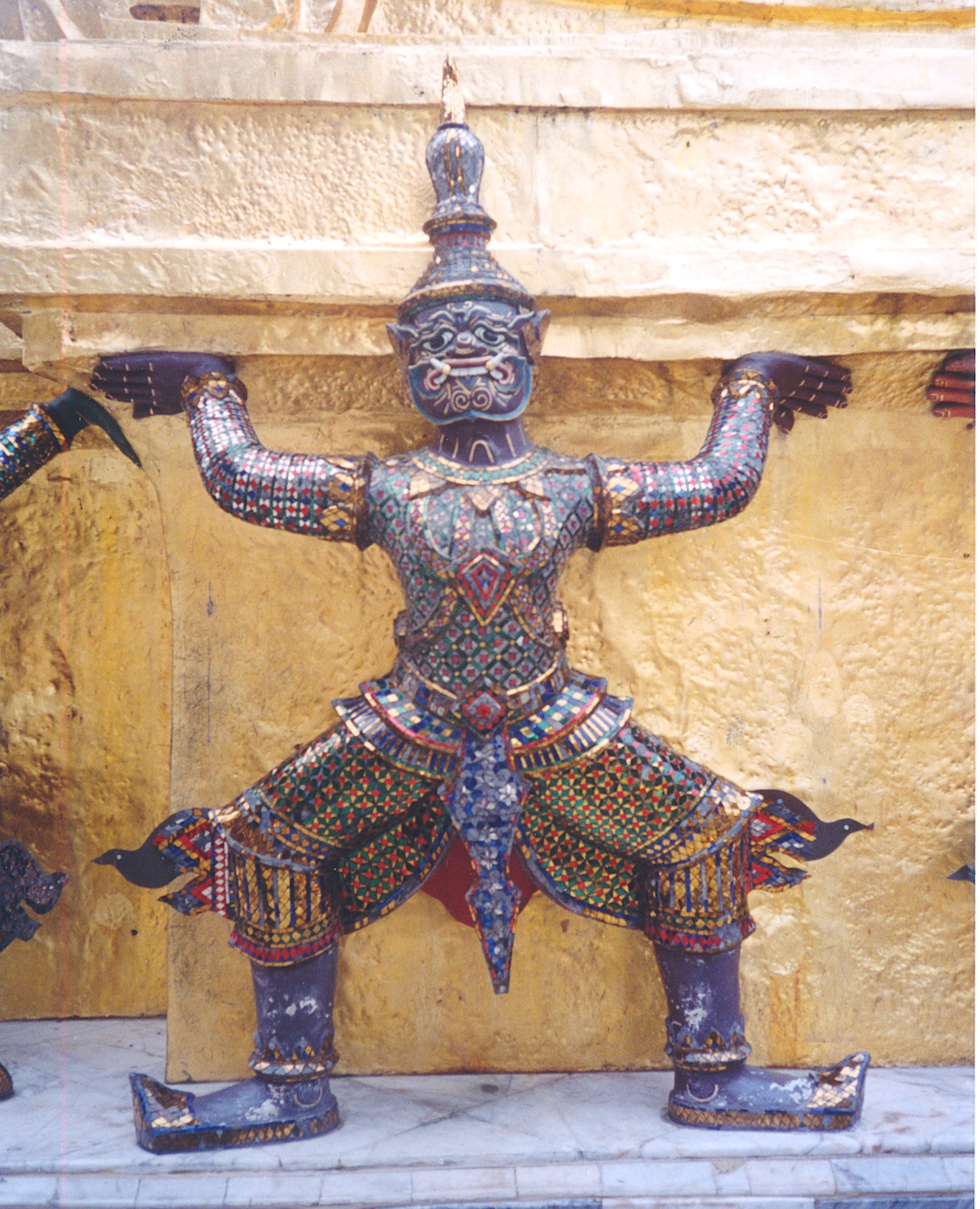
This bubbling, cosmopolitan stew hints at the Thai’s tolerant national character. It is apparent in their architecture. At the Grand Palace in Bangkok, Cambodian spires are encrusted with Italian porcelain, Sri-Lankan, bell-shaped towers are guarded by elephant figurines – gifts of the Dutch. A Thai tour guide proclaims proudly, ‘Here belongs to everybody, not only to Thai,’ and indeed the Thai co-exist peaceably with minority groups such as the Malays as well as the Chinese who enjoy a freedom of religion and tradition in Thailand that has been denied in their own homeland. Taking a wrong turn one night, I wandered into Chinatown and stumbled upon a temple performance – Mandarin robes and painted faces, the strange wailing songs of ancient ritual resurrected far from home.
The Thais’ easy-going natures are such that even religious rites are open to curious gawkers from afar. Wat Po is an important Buddhist monastery in the heart of Bangkok’s tourist district. Entering one of the temples in the compound, I found a Sunday School class underway, led by an earnest, bespectacled monk. The children, in their green-and-white school uniforms, are seated on the floor, boys and girls separated by a central aisle. Another monk, on crowd control duty, swoops to twist the ear of one unruly little worshipper. One of the pupils leads an incantation of prayer. Her classmates respond, alternately prostrating themselves and chanting in unison. Camera-wielding tourists sit with the devotees taking photos as the rituals continue, undisturbed by these curious interlopers.
Religious devotion is everywhere in evidence. On my first foray into the fume-sodden streets of Bangkok, I found a temple bustling with activity. The proceedings, although nothing out of the ordinary, have an air of festival to them as schoolgirls chatter among well-dressed matrons and Levi-clad young men.
In one part of the temple compound a theatrical performance is underway. The diva sits on a raised, ornately gilded couch before a mural of the vast marble halls of a palace. She wears the towering gold head-dress of the classical Thai dancer and is sheathed in apricot silk and sequins. Her face is as stylised and as painted as a mask and her atonal singing is accompanied by an orchestra of traditional instruments. Beggars, children and gossiping old ladies sit on the ground around the stage enjoying the performance. It is striking how life and art and religion is intertwined and daily celebrated. Inside the main temple, roses and elephant tusks are arranged in tribute to the gods. Ivory thrusts upward from the bed of petals in obvious sexual symbolism.
When one leaves Bangkok and its satellite sprawl of service stations, Thailand reveals itself to be … green – the eye-searing green of the tropics, the green of growth that hums in the brackish air. It is a picture painted by a sensualist. Everywhere one is reminded of the force of generation: the palm stem and the coconut, the thrust and lap of the tropical sea which yields shells as phallic as unicorn horns and aureoles as pink as Venus’s nipples. It is little wonder then that the Thais bring to the rituals of Buddhism a celebration of the fertility that surrounds them.
It is the country’s devout observance of Buddhist teachings as well as its long-revered monarchy that help it to resist succumbing wholly to the bland homogeneity of popular Western culture. The concrete conformity of the city’s skyline is broken by the fanciful, curlicued rooftops of Buddhist temples and orange-robed monks weave splashes of exotic colour through the dowdy crowds of their western-clad countrymen. Huge images of the King and Queen decorate the city and every public building or private home boasts a prominently-hung picture of the monarch. Thus, religion and royalty bring an old-world charm to a country facing the economic turmoil of modernisation.
Despite the much-publicised economic downturn, tourism remains Thailand’s foremost foreign exchange earner. The Thais have proved themselves adroit free marketeers energetically catering to the demands of the lucrative tourist trade. Anything and everything is available in Thailand, as I found for myself in the notorious neon strip of Pat Pong Road.
I was immediately accosted by a hard-selling tout who presented me with a programme of such fleshly curiosities as ‘open bottle with pussy’ and ‘frog-in-pussy’. Prompted by the macabre fascination one feels when encountering car-wrecks, I entered the bar – a nondescript, dingy space enlivened by mirrors and livid lighting. A motley scattering of gawping tourists and hardened debauchers surround a raised platform upon which naked girls shuffle, their panties twisted high around one thigh.
Taking turns, the girls perform a variety of anatomical acrobatics. One smokes a cigarette, the puffs of smoke issuing from between her legs in rhythmic clouds. Another sucks up water through a straw, similarly positioned, and then, using a bottle, releases what appears to be Coke. A third proves astonishingly accurate at popping balloons with a blow dart clenched between her thighs. There is an automatic quality to these feats that suggest that they have been performed a thousand times.
These women are not those long-limbed Oriental beauties of popular male fantasy. Cellulite-studded thighs and slack bellies quiver as they sway in absent-minded acknowledgement of the music, occasionally picking at their teeth or vaguely scratching, with blank, unfocused eyes.
The sex trade in Thailand flourished during the Vietnam War when combat-weary GIs would escape to Bangkok for a few brief days of desperate release. With the burgeoning tourist trade of the last decade, the bar-girls of the Vietnam era have become a speciality item and the go-go bars of Pat Pong, Pattaya and Phuket attract many Western enthusiasts. I met an Australian who travelled to Thailand regularly to enjoy the pleasures on offer. Apparently, after the bars close at 2:00 am one can hire a girl’s services for the remainder of the evening and all of the following day for as little as US $20. Little wonder then that sex tourism is one of Thailand’s biggest draw-cards.
Another enticement for the tourist is Thailand’s string of myriad tropical islands and one can combine pleasure with paradise by hiring an ‘escort’ for the duration of one’s vacation.
Incongruous couples are a common sight on the islands. On the ferry en-route to a palm-fringed slice of paradise I spotted one such strangely mismatched pair. Discreetly eavesdropping on their conversation it became apparent that her English was limited but this was obviously no impediment to their association. A middle-aged, balding German, his ample girth barely restrained by his day-glo T-shirt, stood with his companion, an Asian girl, petite and dusky with smudged tattoos on her upper arms and roughened elbows. He enfolded her in a proprietary embrace and patted her rump – a solid sound of flesh on flesh.
Sex and drugs and jungle music is the anthem of the bright young things who flock to the party islands of Ko Samui and Koh Pha Ngan. The latter is notorious for its drug scene and stories circulate of used needles littering the beaches and occasional cases of overdosing. Once a month, a Full Moon party is held on the popular party beach of Haad Rin. European DJs are imported specially for the occasion and they bring with them the latest techno grooves playing in the trendiest night spots of Europe’s capitals. The crowds are massive and the drug intake is proportionate. Ecstasy merchants do a brisk trade as people dance all night in a chemically-induced euphoria. There is a sign on the road to Haad Rin which politely suggests, ‘Enjoy Paradise naturally. We prefer no drugs’. Few visitors take any notice.
Topless Europeans and Israelis soak up the sun on white sand beaches and the locals (ever accommodating) perform the age-old skills of Thai massage on prostrate, semi-naked sun-junkies. The Thais are intentionally transforming considerable areas of their country into a tourist playground and visitors are attracted to Thailand for that very reason. They come to baste their pallid European bodies on tropical beaches; to gorge themselves on cheap seafood and cheap sex.
Few have any interest in the local people or culture. Often the only interaction between the tourists and the locals are those necessitated by material transactions and on some of the most popular islands one can’t help but notice the effect of such tourists on the local inhabitants. Rude and surly service is the norm; lewd suggestions proffered by cruising island boys eager to notch up another sexual adventure with a Western woman, commonplace.
Established cultural values and observances are being steadily eroded by Western influences. In a country as actively religious as Thailand, where instead of military, there is monastic conscription, such a dissolution is all the more apparent.
As the cultural boundaries between East and West rapidly dissolve in these last days of the 20th century, and our world moves increasingly towards a global village, there is bound to be a collision of disparate social and belief systems. In the cultural exchange being effected in the East, one can’t help but feel that Asia is coming off second best in pursuing economic growth at the price of cultural disintegration and environmental degradation. Now that South Africa, too, is falling over itself in its mad scramble for foreign investment and tourist dollars, we might benefit from casting a glance in Thailand’s direction and deliberating for a moment upon the long-term costs of a headlong rush to catch up with the rest of the world. As the Chinese premier Deng Xiaoping once observed about the opening of his own country to the West, ‘If you open the doors, the flies will come in’.