

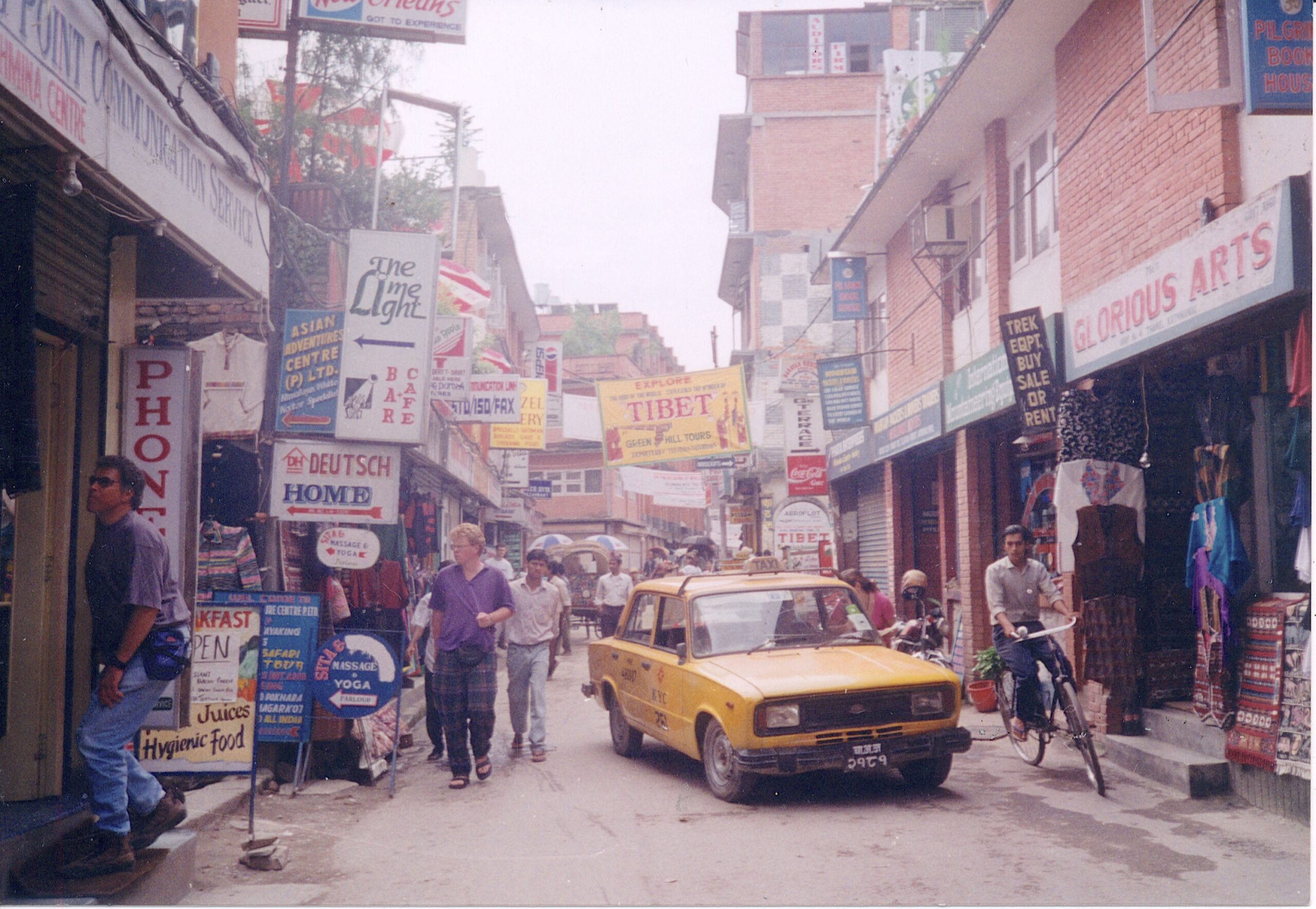
Time-travel, actually. To a medieval mountain kingdom tucked under the roof of the world.
What? No Macdonald’s? No malls? No mai-tais?
Nope. You’ll have to settle for myth, magic and mysticism, I’m afraid. This is no ordinary destination. It is the birthplace of the Buddha, the abode of the gods, and the stomping ground of the abominable snowman.
Ah. The Himalayas.
Well, yes. There are those. Nepal is home to 8 of the 10 highest peaks in the world. Site of the Hindu centre of the universe, they jut through the cloud mass at a height that rightly belongs to the sky. Kilimanjaro is a molehill next to these 8 000-metre big boys.
I’ve conquered Table Mountain, you know. I wouldn’t mind a crack at Everest.
Whoaa, slow down there, tiger. It takes more than an over-dose of self-confidence to conquer these giants. But if dangling off ice-scythed peaks is your thing or hurtling down swollen rivers, you’ll find everything you need in Kathmandu, Nepal’s capital, to outfit you for the adrenalin rush.
Actually, what about something a little more mellow?
Yes, well there’s a lot of that about too. Travellers to these parts have been dropping in – and dropping out – for decades. To the flower-power generation of the ’70s, Kathmandu was the ultimate trip. It still is.
Has nobody told them that Jerry is dead?
You’d be forgiven for thinking you’re having an acid flashback in the tourist ghetto of Thamel. Grateful Dead T-shirts, tie-dyes and Mad Hatter headgear loudly deny the passing of the ’70s. Wannabee ’90s hippies abound.
Aha. The land that time forgot.
Something like that. The first tourists to this once forbidden kingdom arrived in 1955. What they found has changed little in the intervening half-century. Amid the modern bustle of tourists and travellers and touts, the Nepalis conduct their business much as they have done for centuries. The labyrinthine alleys of Kathmandu’s old city teem with beggars and bearers, butchers and barbers, meandering gaggles of geese, holy cows and holy men and – riotously advancing against the seething traffic – the inevitable festival procession.
Why inevitable?
Nepal has more religious festivals and holidays than any country in the world. Sandwiched as it is between China to the north and India to the south, its peoples are as hybrid as the religions that they practise. Hinduism has 3 000 gods; Buddhism has none. The Nepalis embrace both with equal enthusiasm and no sense of contradiction. A geographical springboard to Tibet, Tantric Buddhism as well as indigenous Nepali traditions add to this heady religious brew.
Three thousand gods! How do they keep track?
With difficulty. In Kathmandu, there are more idols and images than people. Weaving through the seething alleyways, a surprise awaits around every corner. Duck now, under a towering platform upon which a god is seated, surveying the melee below. Through there, a Buddhist shrine, its whitewashed mound and spire set in a back-alley courtyard littered with bare-bottomed urchins. Through that temple gate, a stolen glimpse of an enormous stone bull with testicles as big as soccer balls. The Hindus are big on fertility!
Sounds pretty wild!
It gets wilder. Kathmandu’s patron deity is a living goddess. She is chosen as a child from among the ranks of the silversmith caste. When womanhood inevitably arrives, the goddess relinquishes her divinity and a new god-child takes her place. Superstition has it that the man that marries the ex-Kumari is fated to die soon after.
Yes, well, I like my women to be flesh-and-blood myself.
The Nepalis don’t seem to make the same distinction between spirit and flesh. Life and art and religion are all intertwined and celebrated daily. ‘Namaste,’ the Nepali greeting, means ‘I salute the god in you.’ Daily commerce takes place on the steps of temples, erotic carvings decorate sacred monuments and beggars sleep on the pagoda platforms.
Pagodas? Aren’t those Chinese?
A Nepali export, actually. Although the three-tiered brick-and-wood pagodas of Nepal are quite distinct from their more famous Chinese counterparts.
So. Pagodas and palaces, mountains and magic and hippies in the Himalayas. Anything else I should know?
That you’re in luck, perhaps. Nepal offers not one medieval city but three. Back when London had yet to make it on a map, the Kathmandu Valley was a settlement of city-states, each with their own king. Patan and Bakhtapur are now little more than suburbs of Kathmandu but little else has changed. In Bakhtapur, no cars are allowed into its cobbled alleys. Goats and chickens have the right of way. Patan has its own allure. Royal rivalry boosted civic building projects and Patan’s central square boasts, arguably, the most picturesque collection of architecture in the world.
Alright, you’ve convinced me. Stop the world. I want to get off. Then tune in, turn on and drop out, man. But watch out for that yeti.