
Day 1: (18 km)
It’s New Year’s day and we are setting out to explore 121 kilometres of the Middle Zambezi at midsummer. We will be paddling from below the Kariba Dam wall to Mana Pools, a world heritage site with the highest recorded numbers of game and bird life on the Zambezi River. Not a bad start to 2013.
Our guides to this African Eden are aptly named Cloud and Emmanuel. Two Canadian flat-bottomed canoes prove big enough to handle four passengers, camping and cooking equipment, food, drink and enough ice for six days on the summer river. We soon come to appreciate the local fondness for peanut butter. We are on safari with the Peanut Butter Boys.
Hippos and a hamerkop see us off. It’s hot and still, drifting down the gorge. The river carries us at a gentle 7 kilometres an hour, so there’s no real reason to paddle. The river is too deep here for hippos and the banks too steep for big game. Crocs sun themselves on the banks and the warbling, liquid cry of the Piet my Vrou echoes down the gorge. A summer holidaymaker from central Africa, the red-chested cuckoo is seldom seen. Its breeding call, however, is unmistakeable, exhorting people to pick up their hoes for the summer planting season. The white-browed coucal’s trickling call also heralds the rains and follows us down the river. However, it is only on our fourth day that we finally see a rain bird – at eye level – perched on a boat at the water’s edge.
We stop for a lunch of salad, cheese, cold meats and Mazoe orange, under the green expanse of a Natal mahogany, (Trichelia emetica), its distinctive red and black beans scattered underfoot. We paddle in a nearby stream and sit out the worst of the heat. Later, and further down the gorge, we clamber up a waterfall to wallow in rock pools as warm as bath water.
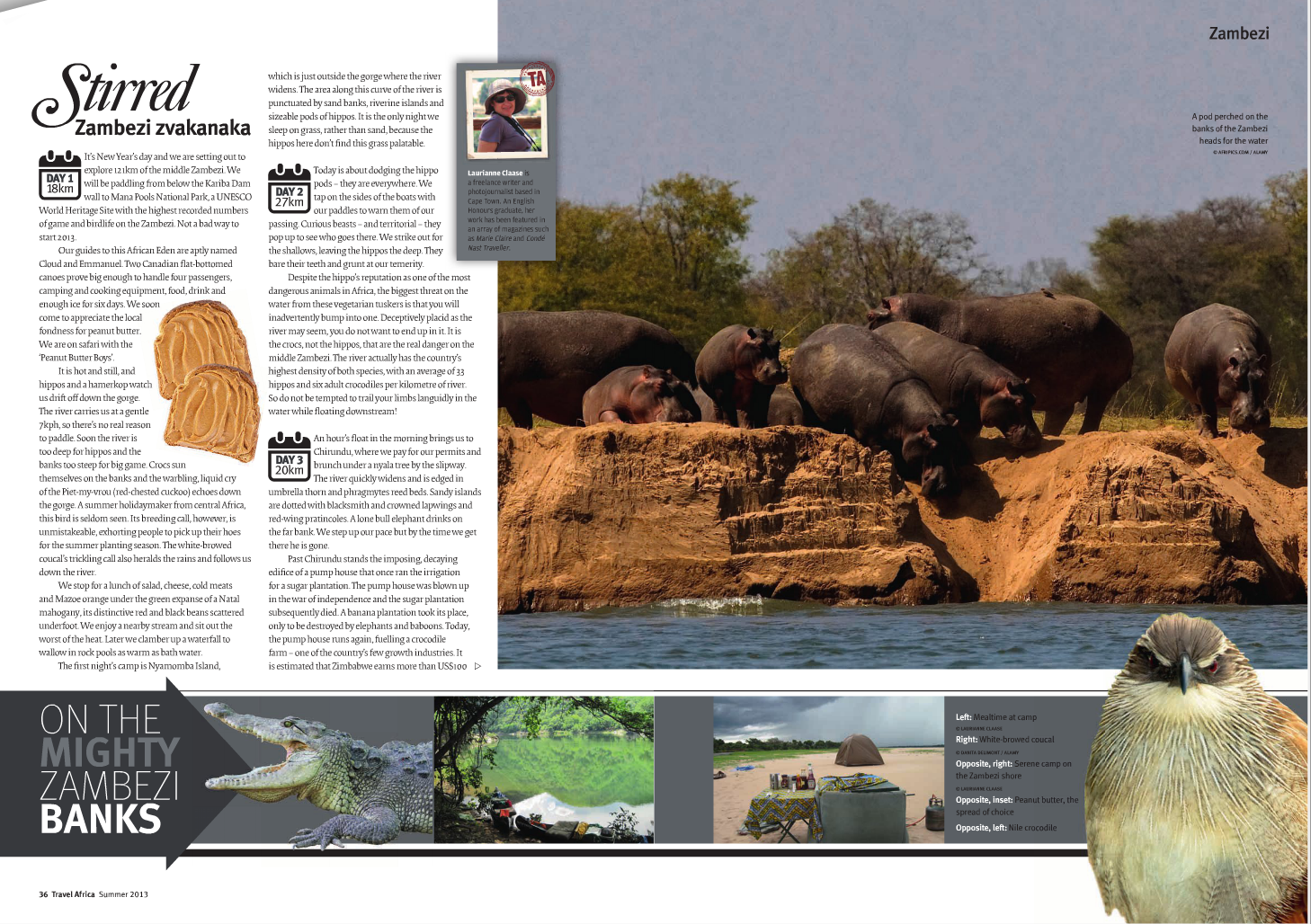
The first night’s camp is Nyamomba Island, just outside the gorge where the river widens, punctuated by sand banks and riverine islands. At least two sizeable hippo pods are resident on this curve of the river. It is the only night we sleep on grass, rather than sand, because the hippos don’t find this grass palatable.
Day 2: (27 km)
Day 2 is about dodging the hippo pods – they are everywhere. We tap on the sides of the boats with our paddles to warn them of our passing. Curious beasts – and territorial – they pop up to see who goes there. We strike out for the shallows, leaving the hippos the deep. They bare their teeth and grunt at our temerity.
Despite its reputation as one of the most dangerous animals in Africa, the biggest threat on the water from these vegetarian tuskers is that you will inadvertently bump into one. Deceptively placid as the river may seem, you do not want to end up in it. It is the crocs, not the hippos that are the real danger on the Middle Zambezi. The Zambezi River has the country’s highest density of hippo and Nile crocodile – 33 hippos and 6 adult crocodiles per kilometre of river. Do not be tempted to trail your limbs languidly in the water while floating downstream!
Day 3: (20 km)
The next morning, an hour’s brief float brings us to Chirundu, where we pay for our permits and brunch under a Nyala tree at the slipway. After Chirundu, the river widens, edged in umbrella thorn and phragmytes reed beds. Sandy islands are dotted in blacksmith and crowned lapwings and red-wing pratincoles. A lone bull elephant drinks on the far bank. We step up our pace but by the time we get there he is gone.
Past Chirundu stands the imposing, decaying edifice of a pump house that once ran the irrigation for a sugar plantation. The pump house was blown up in the war of independence and the sugar plantation died. A banana plantation took its place, only to be destroyed by the elephants and baboons. Today, the pump house runs again, fuelling a crocodile farm – one of the country’s few growth industries. It is estimated that Zimbabwe earns more than US $100 million a year through the export of crocodile meat and skins to countries such as Japan, Singapore, the United States and Australia.
Banks of cloud start to roll in and the sky darkens as the river winds on. Motor boats head for home, trying to outrun the rain. Flocks of snowy egrets whitewash the sooty sky. Just around the final bend, the clouds descend and we pitch camp in the downpour. The rain stops in time to eat dinner. The usual night sounds of snorting hippos are joined by the strains of Zimbabwean sungura music from a disco on the Zambian shore. Fireflies flicker and stars prick the cloud-swept sky.
Day 4: (27 km)
A calm and cloudy morning ushers in Day 4. Bee eaters – blue-cheeked, carmine and little – are breakfasting as we paddle along the Zimbabwean shore, past holiday houses, Mongwe Camp and a new lodge. The shoreline is edged in wild mango and ilala palms, with intermittent baobabs and showers of white leaved combretum. As we round a channel through a reed bed we surprise a hippo and narrowly escape being bumped.
We lunch next to the Nyakasanga River which marks the border between the hunting concessions of the Hurungwe Safari Area and Mana Pools National Park. The hippo pods are so plentiful here that we strike across the river for the Zambian shore. We’ve honed our game-viewing skills by now and spot another thirsty elephant bachelor. This time we get up close and personal and are rewarded with much ear-flapping and trumpeting.
It’s a quiet, sleepy afternoon as we doze on the water, until we approach our camping spot. Cutting across the broad expanse of river as the clouds gather behind us and the day grows dark, we see elephant on the Zambian side. We zigzag back across the one-kilometre-wide river, and enter a shallow bay clogged with dead trees and driftwood. A four-metre-long croc breaks the surface of the water and disappears into the murk. As we are negotiating the submerging croc, a dead tree stump and a bolshie hippo, we manage to get stuck on a sand bank. The elephants are retreating back into the bush but the next minute more arrive. The hippo is gnashing his chompers, the storm is gathering behind us and I’m trying to capture the moment on camera. The pics won’t win any competitions but the memory is indelible.
Day 5: (29 km)
Our last day on the Zambezi. As we paddle past the controversial Chinese-funded lodge that is going up in Mana Pools, we hear the distant rumble of lion and give chase. We find them at Acacia Point – three young juveniles on the edge of the tree line – and watch as they disappear into the bush. The nearby woolly-necked storks are unimpressed.
Fittingly, it is an aggressive bull hippo who welcomes us to Nyamepi campsite in Mana Pools with toothy roars and a mock charge, which results in the fastest pace yet set on this trip. We make landfall unscathed as the rain sets in once more. Zvakanaka is a useful Shona word that means Thank You, Bon Voyage, Merry Christmas and Happy New Year. Zambezi Zvakanaka! We’ll be back.